


Page 50 - Scientech_2018-19
P. 50
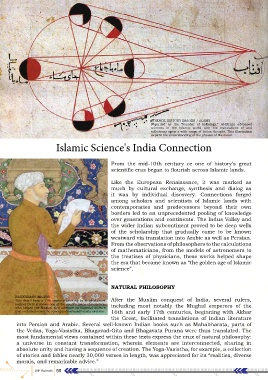
SCIENCE HISTORY IMAGES / ALAMY
                                                                    Regarded as the  “founder of  Indiology,”  Al-Biruni  advanced
                                                                    sciences in the Islamic world with his translations of and
                                                                    reflections upon a wide range of Indus thought. This illustration
                                                                    depicts his understanding of the phases of the moon.
                          Islamic Science's India Connection


                                                  From the mid-10th century ce one of history’s great
                                                  scientific eras began to flourish across Islamic lands.


                                                  Like the European Renaissance, it was marked as
                                                  much by  cultural  exchange, synthesis  and dialog  as
                                                  it was by individual discovery. Connections forged
                                                  among scholars  and scientists  of  Islamic  lands with
                                                  contemporaries and predecessors beyond their  own
                                                  borders led to an unprecedented pooling of knowledge
                                                  over generations and continents. The Indus Valley and
                                                  the wider Indian subcontinent proved to be deep wells
                                                  of  the  scholarship that  gradually  came  to  be  known
                                                  westward via translation into Arabic as well as Persian.
                                                  From the observations of philosophers to the calculations
                                                  of mathematicians, from the models of astronomers to
                                                  the treatises of physicians, these works helped shape
                                                  the era that became known as “the golden age of Islamic
                                                  science”.


                                                  NATURAL PHILOSOPHY

                                                  After the Muslim conquest  of India, several rulers,
                                                  including most notably the Mughal emperors of the
                                                  16th and early 17th centuries, beginning with  Akbar
                                                  the Great, facilitated translations of Indian literature
        into Persian and Arabic. Several well-known Indian books such as Mahabharata, parts of
        the Vedas, Yoga-Vasistha, Bhagavad-Gita and Bhagavata Purana were thus translated. The
        most fundamental views contained within these texts express the crux of natural philosophy:
        a  universe  in  constant  transformation,  wherein  elements  are  interconnected,  sharing in
        absolute unity and having a sequence of creation. The Yoga-Vasistha, for example, a collection
        of stories and fables nearly 30,000 verses in length, was appreciated for its “realities, diverse
        morals, and remarkable advice.”

                 SIF Bahrain 50

