


Page 63 - 2022-08-01 Sound & Vision
P. 63
input board that will be offered as   SETUP                              works out to a respectable $781 per
           an option in the future.                                                channel, which is in line with other
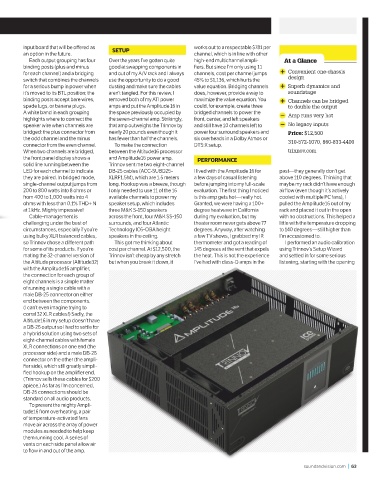
             Each output grouping has four     Over the years I’ve go en quite     high-end multichannel ampli-         At a Glance
           binding posts (plus and minus       good at swapping components in      fiers. But since I’m only using 11
           for each channel) and a bridging    and out of my A/V rack and I always   channels, cost per channel jumps     Convenient one-chassis
           switch that combines the channels   use the opportunity to do a good    45% to $1,136, which hurts the         design
           for a serious bump in power when    dusting and make sure the cables    value equation. Bridging channels      Superb dynamics and
           it’s moved to its BTL position; the   aren’t tangled. For this review, I   does, however, provide a way to     soundstage
           binding posts accept bare wires,    removed both of my ATI power        maximize the value equation. You       Channels can be bridged
           spade lugs, or banana plugs.        amps and put the Amplitude 16 in    could, for example, create three       to double the output
           A white band in each grouping       the space previously occupied by    bridged channels to power the
                                                                                                                          Amp runs very hot
           highlights where to connect the     the seven-channel amp. Strikingly,   front, center, and le  speakers
           speaker wire when channels are      that amp outweighs the Trinnov by   and still have 10 channels le  to      No legacy inputs
           bridged: the plus connector from    nearly 20 pounds even though it     power four surround speakers and       Price: $12,500
           the odd channel and the minus       has fewer than half the channels.    six overheads in a Dolby Atmos or
                                                                                                                          310-572-1070, 860-833-4400
           connector from the even channel.      To make the connection            DTS:X setup.
           When two channels are bridged,      between the Altitude16 processor                                           trinnov.com
           the front panel display shows a     and Amplitude16 power amp,           PERFORMANCE
           solid line running between the      Trinnov sent me two eight-channel
           LED for each channel to indicate    DB-25 cables (ACC-SUBD25-           I lived with the Amplitude 16 for   past—they generally don’t get
           they are paired. In bridged mode,   XLRF1.5M), which are 1.5 meters     a few days of casual listening     above 110 degrees. Thinking that
           single-channel output jumps from    long. Hookup was a breeze, though   before jumping into my full-scale   maybe my rack didn’t have enough
           200 to 800 wa s into 8 ohms or      I only needed to use 11 of the 16   evaluation. The first thing I noticed   airflow (even though it’s actively
           from 400 to 1,000 wa s into 4       available channels to power my      is this amp gets hot—really hot.   cooled with multiple PC fans), I
           ohms with less than 0.1% THD+ N     speaker setup, which includes       Granted, we were having a 100+     pulled the Amplitude16 out of my
           at 1 kHz. Mighty impressive!        three M&K S-150 speakers            degree heatwave in California      rack and placed it out in the open
             Cable-management is               across the front, four M&K SS-150   during my evaluation, but my       with no obstructions. This helped a
           challenging under the best of       surrounds, and four Atlantic        theater room never gets above 77   li le with the temperature dropping
           circumstances, especially if you’re   Technology IC6-OBA height         degrees. Anyway, a er watching     to 140 degrees—still higher than
           using bulky XLR balanced cables,    speakers in the ceiling.            a few TV shows, I grabbed my IR    I’m accustomed to.
           so Trinnov chose a different path      This got me thinking about        thermometer and got a reading of      I performed an audio calibration
           for some of its products. If you’re   cost per channel. At $12,500, the   145 degrees at the vent that expels   using Trinnov’s Setup Wizard
           mating the 32-channel version of    Trinnov isn’t cheap by any stretch   the heat. This is not the experience   and se led in for some serious
           the Altitude processor (Altitude32)   but when you break it down, it    I’ve had with class-D amps in the   listening, starting with the opening
           with the Amplitude16 amplifier,
           the connection for each group of
           eight channels is a simple ma er
           of running a single cable with a
           male DB-25 connector on either
           end between the components.
           (I can’t even imagine trying to
           corral 32 XLR cables!) Sadly, the
           Altitude16 in my setup doesn’t have
           a DB-25 output so I had to se le for
           a hybrid solution using two sets of
           eight-channel cables with female
           XLR connections on one end (the
           processor side) and a male DB-25
           connector on the other (the ampli-
           fier side), which still greatly simpli-
           fied hookup on the amplifier end.
           (Trinnov sells these cables for $200
           apiece.) As far as I’m concerned,
           DB-25 connections should be
           standard on all audio products.
             To prevent the mighty Ampli-
           tude16 from overheating, a pair
           of temperature-activated fans
           move air across the array of power
           modules as needed to help keep
           them running cool. A series of
           vents on each side panel allow air
           to flow in and out of the amp.

                                                                                                                                                   [
                                                                                                                                 soundandvision.com       63

