


Page 162 - 2022-08-01 Paddling Magazine
P. 162
KAYAKING


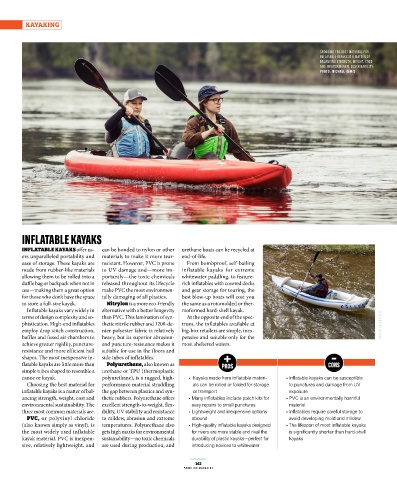
                                                                                                          CHOOSING THE BEST MATERIAL FOR
                                                                                                          INFLATABLE KAYAKS IS A MATTER OF
                                                                                                          BALANCING STRENGTH, WEIGHT, COST
                                                                                                          AND ENVIRONMENTAL SUSTAINABILITY.
                                                                                                          PHOTO: MICHAEL HEWIS


        INFLATABLE KAYAKS

        INFLATABLE KAYAKS offer us-  can be bonded to nylon or other   urethane boats can be recycled at
        ers unparalleled portability and   materials to make it more tear-  end-of-life.
        ease of storage. These kayaks are   resistant. However, PVC is prone   From bombproof, self-bailing
        made from rubber-like materials   to UV damage and—more im-  inflatable kayaks for extreme
        allowing them to be rolled into a   portantly—the toxic chemicals   whitewater paddling, to feature-
        duffle bag or backpack when not in   released throughout its lifecycle   rich inflatables with covered decks
        use—making them a great option   make PVC the most environmen-  and gear storage for touring, the
        for those who don’t have the space   tally damaging of all plastics.   best blow-up boats will cost you
        to store a full-size kayak.   Nitrylon is a more eco-friendly   the same as a rotomolded or ther-
          Inflatable kayaks vary widely in   alternative with a better longevity   moformed hard-shell kayak.
        terms of design complexity and so-  than PVC. This lamination of syn-  At the opposite end of the spec-
        phistication. High-end inflatables   thetic nitrile rubber and 1200-de-  trum, the inflatables available at           PHOTO: COLIN FIELD
        employ drop stitch construction,   nier polyester fabric is relatively   big-box retailers are simple, inex-
        baffles and fused air chambers to   heavy, but its superior abrasion-   pensive and suitable only for the
        achieve greater rigidity, puncture-  and puncture-resistance makes it   most sheltered waters.
        resistance and more efficient hull   suitable for use in the floors and
        shapes. The most inexpensive in-  side tubes of inflatables.      +                                  –
        flatable kayaks are little more than   Polyurethane, also known as   PROS                           CONS
        simple tubes shaped to resemble a   urethane or TPU (thermoplastic
        canoe or kayak.           polyurethane), is a rugged, high-  •   Kayaks made from inflatable materi-  •  Inflatable kayaks can be susceptible
          Choosing the best material for   performance material straddling   als can be rolled or folded for storage   to punctures and damage from UV
        inflatable kayaks is a matter of bal-  the gap between plastics and syn-  or transport  exposure
        ancing strength, weight, cost and   thetic rubbers. Polyurethane offers   •  Many inflatables include patch kits for   •  PVC is an environmentally harmful
        environmental sustainability. The   excellent strength-to-weight, flex-  easy repairs to small punctures  material
        three most common materials are:  ibility, UV stability and resistance   •  Lightweight and inexpensive options   •  Inflatables require careful storage to
          PVC, or polyvinyl chloride   to mildew, abrasion and extreme   abound                avoid developing mold and mildew
        (also known simply as vinyl), is   temperatures. Polyurethane also   •  High-quality inflatable kayaks designed   •  The lifespan of most inflatable kayaks
        the most widely used inflatable   gets high marks for environmental   for rivers are more stable and rival the   is significantly shorter than hard-shell
        kayak material. PVC is inexpen-  sustainability—no toxic chemicals   durability of plastic kayaks—perfect for   kayaks
        sive, relatively lightweight, and   are used during production, and   introducing novices to whitewater


                                                                 162
                                                             P A D D L IN G  M A G A Z IN E

