


Page 158 - 2022-08-01 Paddling Magazine
P. 158
KAYAKING


                                                                                      THERMOFORM KAYAKS


                                                                                      THERMOFORM KAYAKS offer a superb, mid-
                                                                                      range compromise between polyethylene and
                                                                                      composite kayaks.
                                                                                        Thermoformed kayaks use an advanced plastic
                                                                                      laminate construction to combine the affordability
                                                                                      and durability of plastic
                                                                                      with the lighter weight,   +
                                                                                      shiny aesthetics and sleek   PROS
                                                                                      feel of composites. Since
                                                                                      manufacturing is signifi-  •  More scratch-resis-
                                                                   COMPOSITE KAYAKS
                                                                   ARE LIGHTER ON YOUR   cantly less labor-intensive   tant and lighter than
                                                                   SHOULDER, BUT NOT   than composite construc-  rotomolded polyeth-
                                                                   ON YOUR WALLET.
                                                                   PHOTO: ONTARIO     tion, thermoformed kayaks   ylene kayaks
                                                                   TOURISM            are priced only marginally   •  Acrylic outer layer
                                                                                      above rotomolded.    provides a glossy
                                                                                        The thermoforming   finish that looks like
        COMPOSITE KAYAKS                                                              process uses a vacuum   more expensive
                                                                                      to wrap heated plastic
                                                                                                           composite kayaks
        COMPOSITE KAYAKS in-     Aramid fiber—synony-  and evenly than hand-pressing   sheets over the kayak   •   Attractive price-to-
        clude those made from lami-  mous with the brand Kevlar—  the layers, but some compos-  molds, allowing designers   performance ratio
        nates of fiberglass, aramid fi-  offers strength and rigidity sim-  ite expedition kayaks are still   to produce finer lines and   •  Easier to repair than
        ber, carbon fiber, or a blending   ilar to fiberglass, but is lighter   built entirely by hand. Finally,   more complex shapes   polyethylene and
        of these and other high-tech   and more expensive. Aramid   fiberglass tape and resin join   while using less material   can be recycled at
        synthetic fabrics. Some man-  and fiberglass-aramid blends   the deck and the hull together.  than rotomolding. Less   end-of-life
        ufacturers also add foam or   are more common in weight-  Composite kayaks are beau-  material is not only more
        honeycomb cores between the   saving light touring kayaks,   tiful to look at and efficient   efficient, it also results in   –
        fabric layers for extra rigidity.  expedition kayaks and surfskis.  to paddle. This construction   a lighter kayak. Deck and   CONS
          The primary differences be-  Carbon fiber is the light-  allows for sleeker lines than   hull are thermoformed
        tween these various composite   est and most costly compos-  rotomolding or thermoform-  separately, then trimmed,   •  UV-exposed ABS
        kayak materials are weight and   ite kayak material. While it is   ing, and composites are stiffer   detailed and joined at the   will degrade over
        cost, with the lightest materials   typically used in elite sport and   than plastics, making them   sheerline with adhesive   time, even with
        being the most expensive. If a   racing kayaks, ultralight carbon   faster and more responsive   and tape.  proper maintenance.
        kayak has a composite con-  rec and touring kayaks are also   on the water.     The plastic sheet mate-  Store your kayak
        struction, be sure to clarify   available.     Composites, especially pre-    rial used to make ther-  indoors, if possible,
        which material it’s made of.   Whichever fabrics are used,   mium layups like carbon fiber   moformed kayaks fuses   or upside-down on
        The three most common are:  all composite kayaks take shape   and aramid, are also lighter on   an impact-resistant ABS   an outdoor rack
          Fiberglass is the original,   in a similar way. Gelcoat is   your shoulder—but not on   plastic base layer to one   •  Be cautious in
        tried-and-true composite ma-  sprayed into separate deck and   your wallet. These are the most   or more thin outer layers   cold climates. At
        terial. The excellent strength-  hull molds followed by hand-  expensive hard-shell kayaks.   of glossy acrylic. It’s this   below-freezing
        to-weight ratio and affordable   laid layers of cloth bonded by   Still, the longevity of compos-  shiny, scratch- and UV-  temperatures, hard
        cost of fiberglass makes it the   resin. Vacuum bag technology   ite kayak materials means that   resistant acrylic cap that   impacts can shatter
        most popular choice for pre-  allows the resin to be injected   a one-time investment can last   gives thermoform kayaks   thermoformed plas-
        mium sea kayaks.       and distributed more quickly   your whole paddling career.  their head-turning finish.  tic laminate
                                                                                        Whether you are in the   •  Many manufacturers
                       +                                  –                           market for a premium rec   don’t offer thermo-
                                                                                      kayak, lighter weight fish-
                                                                                                           formed kayaks—this
                      PROS                               CONS                         ing kayak or expedition-  material might not
                                                                                      ready touring kayak,   be an option if you
          •  Lightweight construction with a superb   • Most expensive hard-shell kayak material  there’s a thermoformed   have your heart set
           strength-to-weight ratio          •  The stiffness of composites makes them   option to suit your needs   on a specific design
          •  Performance, responsiveness and effi-  susceptible to severe cracks and punc-  and budget.
           ciency are superior to polyethylene kayaks  tures from direct hits. Avoid surfing into
          •  Scratches, spider cracks and even punc-  rocks or banging down bony rivers
           tures can be garage or field repaired with   •  Used kayak shoppers are likely to encoun-
           minimal tools and a YouTube education  ter retro teal-and-purple color schemes
          •  Composites are UV-resistant and abra-  and outdated outfitting, since well cared
           sions leave smooth scratches, which don’t   for composite kayaks can still charge
           impair hull speed                  decades after their prime
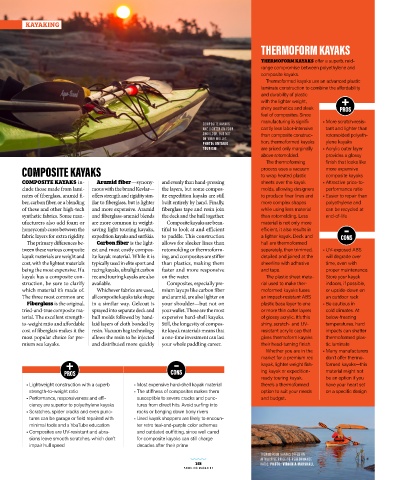
                                                                                      THERMOFORM KAYAKS OFFER AN
                                                                                      ATTRACTIVE PRICE-TO-PERFORMANCE
                                                                 158                  RATIO. PHOTO: VIRGINIA MARSHALL
                                                             P A D D L IN G  M A G A Z IN E

