


Page 157 - 2022-08-01 Paddling Magazine
P. 157
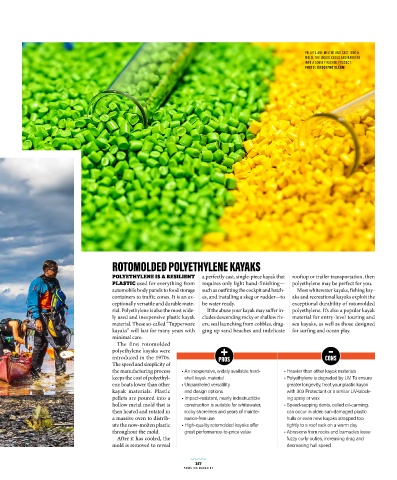
PELLETS ARE MELTED AND CAST INTO A
                                                                                                     MOLD. THE LIQUID COOLS AND HARDENS
                                                                                                     INTO A SOLID FINISHED PRODUCT.
                                                                                                     PHOTO: ISTOCKPHOTO.COM


                                      ROTOMOLDED POLYETHYLENE KAYAKS

                                      POLYETHYLENE IS A RESILIENT   a perfectly cast, single-piece kayak that   rooftop or trailer transportation, then
                                      PLASTIC used for everything from   requires only light hand-finishing—  polyethylene may be perfect for you.
                                      automobile body panels to food storage   such as outfitting the cockpit and hatch-  Most whitewater kayaks, fishing kay-
                                      containers to traffic cones. It is an ex-  es, and installing a skeg or rudder—to   aks and recreational kayaks exploit the
                                      ceptionally versatile and durable mate-  be water ready.  exceptional durability of rotomolded
                                      rial. Polyethylene is also the most wide-  If the abuse your kayak may suffer in-  polyethylene. It’s also a popular kayak
                                      ly used and inexpensive plastic kayak   cludes descending rocky or shallow riv-  material for entry-level touring and
                                      material. These so-called “Tupperware   ers, seal launching from cobbles, drag-  sea kayaks, as well as those designed
                                      kayaks” will last for many years with   ging up sand beaches and indelicate   for surfing and ocean play.
                                      minimal care.
                                       The  first  rotomolded
                                      polyethylene kayaks were           +                                  –
                                      introduced in the 1970s.          PROS                               CONS
                                      The speed and simplicity of
                                      the manufacturing process   •  An inexpensive, widely available hard-  • Heavier than other kayak materials
                                      keeps the cost of polyethyl-  shell kayak material      •  Polyethylene is degraded by UV. To ensure
                                      ene boats lower than other   •  Unparalleled versatility    greater longevity, treat your plastic kayak
                                      kayak materials. Plastic   and design options            with 303 Protectant or a similar UV-block-
                                      pellets are poured into a   •  Impact-resistant, nearly indestructible   ing spray or wax
                                      hollow metal mold that is   construction is suitable for whitewater,   •  Speed-sapping dents, called oil-canning,
                                      then heated and rotated in   rocky shorelines and years of mainte-  can occur in older, sun-damaged plastic
                                      a massive oven to distrib-  nance-free use               hulls or even new kayaks strapped too
                                      ute the now-molten plastic   •  High-quality rotomolded kayaks offer   tightly to a roof rack on a warm day
                                      throughout the mold.   great performance-to-price value  •  Abrasions from rocks and barnacles leave
                                       After it has cooled, the                                fuzzy curly-outies, increasing drag and
                                      mold is removed to reveal                                decreasing hull speed


                                                                 157
                                                             P A D D L IN G  M A G A Z IN E

