


Page 100 - A Mind For Numbers: How to Excel at Math and Science
P. 100
processes, because it can march mindlessly along. It’s far easier to enlist a
               friendly zombie habit to help with a process than to help with a product.


                                                   X MARKS THE SPOT!


                   “It’s a good idea to mark the objective of your daily reading assignment with a bookmark
                   (or Post-it note). This gives immediate feedback on progress—you are more motivated
                   when you can see the finish line!”

                          —Forrest Newman, Professor of Astronomy and Physics, Sacramento City College


               Break Your Work into Bite-Sized Pieces—Then Work Intently,

               but Briefly


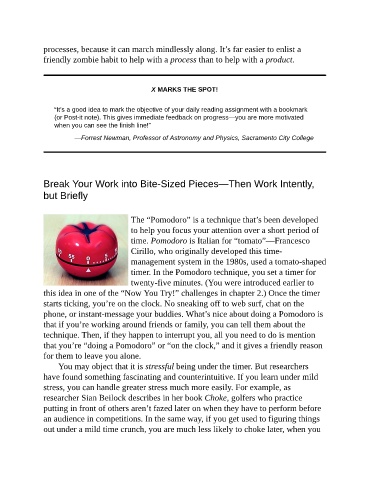
                                            The “Pomodoro” is a technique that’s been developed
                                            to help you focus your attention over a short period of
                                            time. Pomodoro is Italian for “tomato”—Francesco
                                            Cirillo, who originally developed this time-
                                            management system in the 1980s, used a tomato-shaped

                                            timer. In the Pomodoro technique, you set a timer for
                                            twenty-five minutes. (You were introduced earlier to
               this idea in one of the “Now You Try!” challenges in chapter 2.) Once the timer
               starts ticking, you’re on the clock. No sneaking off to web surf, chat on the
               phone, or instant-message your buddies. What’s nice about doing a Pomodoro is
               that if you’re working around friends or family, you can tell them about the
               technique. Then, if they happen to interrupt you, all you need to do is mention

               that you’re “doing a Pomodoro” or “on the clock,” and it gives a friendly reason
               for them to leave you alone.
                    You may object that it is stressful being under the timer. But researchers
               have found something fascinating and counterintuitive. If you learn under mild
               stress, you can handle greater stress much more easily. For example, as
               researcher Sian Beilock describes in her book Choke, golfers who practice

               putting in front of others aren’t fazed later on when they have to perform before
               an audience in competitions. In the same way, if you get used to figuring things
               out under a mild time crunch, you are much less likely to choke later, when you

