


Page 164 - A Mind For Numbers: How to Excel at Math and Science
P. 164
2
               their deeply ingrained repertoire of chunks.  At some point, self-consciously
               “understanding” why you do what you do just slows you down and interrupts
               flow, resulting in worse decisions.
                    Teachers and professors can inadvertently get too caught up in following
               rules. In an intriguing study that illustrates this, six people were filmed doing
                                                                               3
               CPR, only one of whom was a professional paramedic.  Professional paramedics
               were then asked to guess who was the real paramedic. Ninety percent of these

               “real deal” expert paramedics chose correctly, remarking along the lines of “he
                                                          4
               seemed to know what he was doing.”  CPR instructors, on the other hand, could
               pick the real paramedic out of the lineup only 30 percent of the time. These
               overly picky theoreticians criticized the real experts in the films for issues such
               as not taking the time to stop and measure where to put their hands. Precise rule
               following had come to mean more to the instructors than practicality.


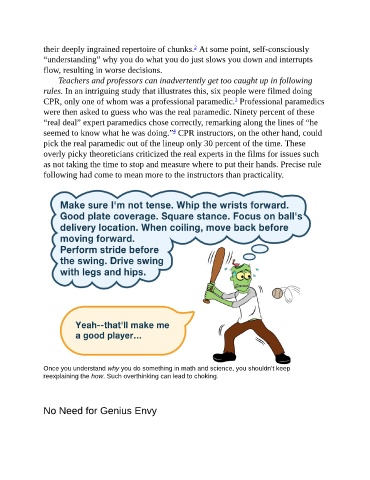
               Once you understand why you do something in math and science, you shouldn’t keep
               reexplaining the how. Such overthinking can lead to choking.


               No Need for Genius Envy

