


Page 25 - A Mind For Numbers: How to Excel at Math and Science
P. 25
thinking on, making it easier to grasp the concepts.


               Focused versus Diffuse Thinking


               Since the very beginning of the twenty-first century, neuroscientists have been

               making profound advances in understanding the two different types of networks
               that the brain switches between—highly attentive states and more relaxed resting
                                 1
               state networks.  We’ll call the thinking processes related to these two different
               types of networks the focused mode and diffuse mode, respectively—these
                                                              2
               modes are highly important for learning.  It seems you frequently switch back
               and forth between these two modes in your day-to-day activities. You’re in either
               one mode or the other—not consciously in both at the same time. The diffuse

               mode does seem to be able to work quietly in the background on something you
                                                3
               are not actively focusing on. Sometimes you may also flicker for a rapid
               moment to diffuse-mode thinking.
                    Focused-mode thinking is essential for studying math and science. It
               involves a direct approach to solving problems using rational, sequential,
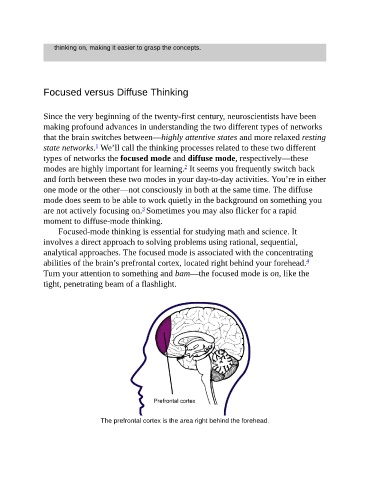
               analytical approaches. The focused mode is associated with the concentrating

               abilities of the brain’s prefrontal cortex, located right behind your forehead.        4
               Turn your attention to something and bam—the focused mode is on, like the
               tight, penetrating beam of a flashlight.


                                  The prefrontal cortex is the area right behind the forehead.

