


Page 27 - A Mind For Numbers: How to Excel at Math and Science
P. 27
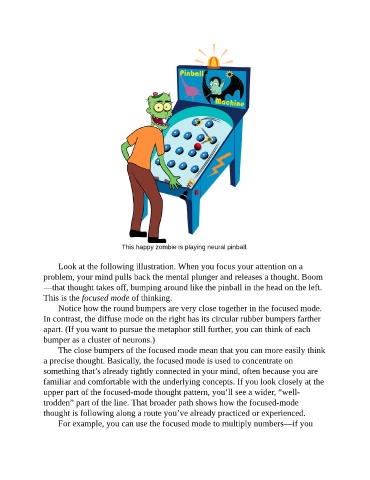
This happy zombie is playing neural pinball.


                    Look at the following illustration. When you focus your attention on a
               problem, your mind pulls back the mental plunger and releases a thought. Boom

               —that thought takes off, bumping around like the pinball in the head on the left.
               This is the focused mode of thinking.
                    Notice how the round bumpers are very close together in the focused mode.
               In contrast, the diffuse mode on the right has its circular rubber bumpers farther
               apart. (If you want to pursue the metaphor still further, you can think of each
               bumper as a cluster of neurons.)

                    The close bumpers of the focused mode mean that you can more easily think
               a precise thought. Basically, the focused mode is used to concentrate on
               something that’s already tightly connected in your mind, often because you are
               familiar and comfortable with the underlying concepts. If you look closely at the
               upper part of the focused-mode thought pattern, you’ll see a wider, “well-
               trodden” part of the line. That broader path shows how the focused-mode
               thought is following along a route you’ve already practiced or experienced.

                    For example, you can use the focused mode to multiply numbers—if you

