


Page 28 - A Mind For Numbers: How to Excel at Math and Science
P. 28
already know how to multiply, that is. If you’re studying a language, you might
               use the focused mode to become more fluent with the Spanish verb conjugation
               you learned last week. If you’re a swimmer, you might use the focused mode to
               analyze your breaststroke as you practice staying low to allow more energy to go
               into your forward motion.
                    When you focus on something, the consciously attentive prefrontal cortex
               automatically sends out signals along neural pathways. These signals link

               different areas of your brain related to what you’re thinking about. This process
               is a little like an octopus that sends its tentacles to different areas of its
               surroundings to fiddle with whatever it’s working on. The octopus has only so
               many tentacles to make connections, just as your working memory has only so
               many things it can hold at once. (We’ll talk more about the working memory
               later.)


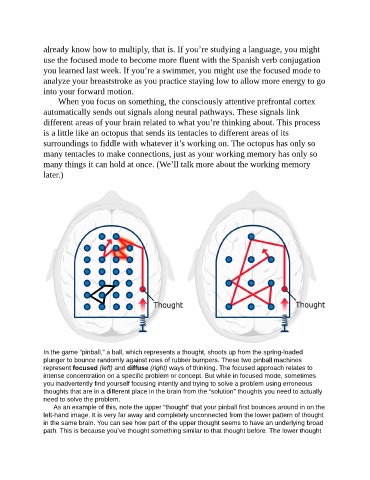
               In the game “pinball,” a ball, which represents a thought, shoots up from the spring-loaded
               plunger to bounce randomly against rows of rubber bumpers. These two pinball machines
               represent focused (left) and diffuse (right) ways of thinking. The focused approach relates to
               intense concentration on a specific problem or concept. But while in focused mode, sometimes
               you inadvertently find yourself focusing intently and trying to solve a problem using erroneous
               thoughts that are in a different place in the brain from the “solution” thoughts you need to actually
               need to solve the problem.
                   As an example of this, note the upper “thought” that your pinball first bounces around in on the
               left-hand image. It is very far away and completely unconnected from the lower pattern of thought
               in the same brain. You can see how part of the upper thought seems to have an underlying broad
               path. This is because you’ve thought something similar to that thought before. The lower thought

