


Page 33 - A Mind For Numbers: How to Excel at Math and Science
P. 33
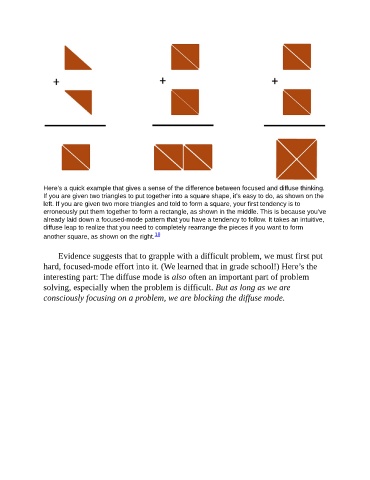
Here’s a quick example that gives a sense of the difference between focused and diffuse thinking.
               If you are given two triangles to put together into a square shape, it’s easy to do, as shown on the
               left. If you are given two more triangles and told to form a square, your first tendency is to
               erroneously put them together to form a rectangle, as shown in the middle. This is because you’ve
               already laid down a focused-mode pattern that you have a tendency to follow. It takes an intuitive,
               diffuse leap to realize that you need to completely rearrange the pieces if you want to form
               another square, as shown on the right. 18


                    Evidence suggests that to grapple with a difficult problem, we must first put
               hard, focused-mode effort into it. (We learned that in grade school!) Here’s the
               interesting part: The diffuse mode is also often an important part of problem

               solving, especially when the problem is difficult. But as long as we are
               consciously focusing on a problem, we are blocking the diffuse mode.

