


Page 147 - Physics Form 5 KSSM_Neat
P. 147
2.  Turn on the power supply so that current flows into the copper wire. Observe the movement of   CHAPTER 4
                the copper wire.
              3.  Turn off the power supply. Reverse the connections to the power supply so that the current in   Electromagnetism
                the copper wire is reversed.
              4.  Turn on the power supply again. Observe the movement of copper wire.
              5.  Turn off the power supply. Remove the steel yoke, reverse the poles of the Magnadur magnets
              KEMENTERIAN PENDIDIKAN MALAYSIA
                and put back the steel yoke.
              6.  Turn on the power supply and observe the movement of copper wire.

              Discussion:
              1.  Describe the motion of the copper wire when the power supply is turned on.
              2.  What is the effect on the copper wire when:
                (a)  the direction of the current is reversed?
                (b)  the poles of the magnet are reversed?
              3.  State two factors that affect the direction of the force acting on the current-carrying conductor.


                 When a current-carrying conductor is placed in a magnetic        SCAN ME
                                                                                  SCAN ME
             field, the conductor will experience a force. The direction of the      Video on formation
             force depends on the direction of the current and the direction         of force
             of the magnetic field.
                                                                                 http://bit.ly/3jajz5s

             Pattern on Resultant Magnetic Field
                                                                                LET’S RECALL
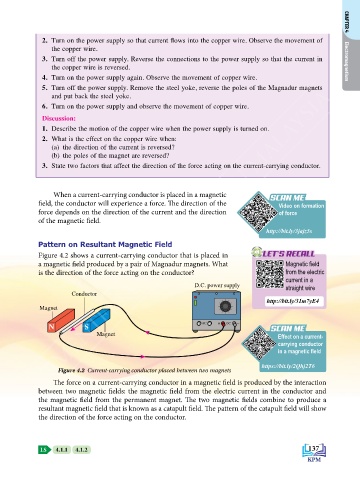
             Figure 4.2 shows a current-carrying conductor that is placed in    LET’S RECALL
             a magnetic field produced by a pair of Magnadur magnets. What             Magnetic field
             is the direction of the force acting on the conductor?                    from the electric
                                                                                       current in a
                                                           D.C. power supply           straight wire
                       Conductor
                                                                                 http://bit.ly/31m7yE4
             Magnet

                                                              AC  +  DC  –
                N         S                                                       SCAN ME
                                                                                  SCAN ME
                              Magnet                                                Effect on a current-
                                                                                    carrying conductor
                                                                                    in a magnetic field

                                                                                https://bit.ly/2Qhj2T6
                  Figure 4.2  Current-carrying conductor placed between two magnets
                 The force on a current-carrying conductor in a magnetic field is produced by the interaction
             between two magnetic fields: the magnetic field from the electric current in the conductor and
             the magnetic field from the permanent magnet. The two magnetic fields combine to produce a
             resultant magnetic field that is known as a catapult field. The pattern of the catapult field will show
             the direction of the force acting on the conductor.


             LS   4.1.1  4.1.2                                                                137

