


Page 260 - Physics Form 5 KSSM_Neat
P. 260
21st Century Challenge


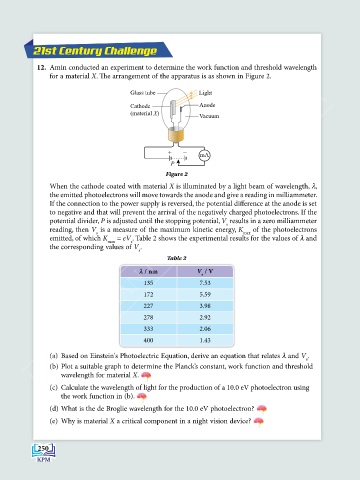
             12.  Amin conducted an experiment to determine the work function and threshold wavelength
                for a material X. The arrangement of the apparatus is as shown in Figure 2.

            KEMENTERIAN PENDIDIKAN MALAYSIA
                                        Glass tube           Light
                                        Cathode              Anode
                                        (material X)         Vacuum


                                                   +    _    mA
                                                    P
                                                   Figure 2
                When the cathode coated with material X is illuminated by a light beam of wavelength, l,
                the emitted photoelectrons will move towards the anode and give a reading in milliammeter.
                If the connection to the power supply is reversed, the potential difference at the anode is set
                to negative and that will prevent the arrival of the negatively charged photoelectrons. If the
                potential divider, P is adjusted until the stopping potential, V  results in a zero milliammeter
                                                                     s
                reading, then V  is a measure of the maximum kinetic energy, K max  of the photoelectrons
                              s
                emitted, of which K max  = eV . Table 2 shows the experimental results for the values of l and
                                        s
                the corresponding values of V .
                                           s
                                                   Table 2
                                           l / nm           V  / V
                                                              s
                                            135              7.53
                                            172              5.59

                                            227              3.98
                                            278              2.92
                                            333              2.06
                                            400              1.43

                (a)  Based on Einstein's Photoelectric Equation, derive an equation that relates l and V .
                                                                                             s
                (b) Plot a suitable graph to determine the Planck’s constant, work function and threshold
                   wavelength for material X.
                (c)  Calculate the wavelength of light for the production of a 10.0 eV photoelectron using
                   the work function in (b).

                (d) What is the de Broglie wavelength for the 10.0 eV photoelectron?
                (e)  Why is material X a critical component in a night vision device?


            250

