


Page 77 - Physics Form 5 KSSM_Neat
P. 77
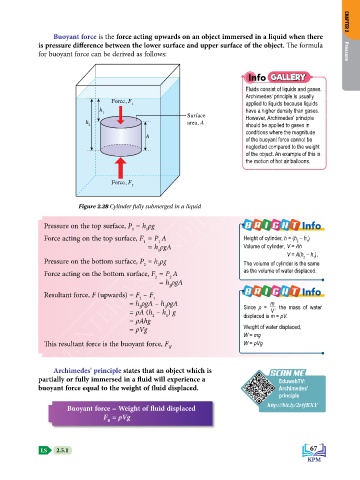
Buoyant force is the force acting upwards on an object immersed in a liquid when there   CHAPTER 2
             is pressure difference between the lower surface and upper surface of the object. The formula
             for buoyant force can be derived as follows:                                                Pressure


                                                                            Info GALLERY
                                                                           Fluids consist of liquids and gases.
              KEMENTERIAN PENDIDIKAN MALAYSIA
                                                                           Archimedes' principle is usually
                                  Force, F                                 applied to liquids because liquids
                                         1
                               h                                           have a higher density than gases.
                                1
                                                         Surface           However, Archimedes' principle
                           h                             area, A
                            2                                              should be applied to gases in
                                                                           conditions where the magnitude
                                             h
                                                                           of the buoyant force cannot be
                                                                           neglected compared to the weight
                                                                           of the object. An example of this is
                                                                           the motion of hot air balloons.

                                  Force, F
                                         2

                         Figure 2.28 Cylinder fully submerged in a liquid

              Pressure on the top surface, P  = h ρg                                        Info
                                         1   1
              Force acting on the top surface, F  = P A                   Height of cylinder, h = (h  – h )
                                                                                          2
                                            1
                                                 1
                                                                                             1
                                             = h ρgA                      Volume of cylinder, V = Ah
                                                1                                      V = A(h  – h ),
                                                                                               1
                                                                                            2
              Pressure on the bottom surface, P  = h ρg                   The volume of cylinder is the same
                                            2   2
              Force acting on the bottom surface, F  = P A                as the volume of water displaced.
                                                2   2
                                                 = h ρgA
                                                    2
              Resultant force, F (upwards) = F  – F 1                                       Info
                                           2
                                        = h ρgA – h ρgA                   Since  ρ  =   m ,  the  mass  of  water
                                           2
                                                  1
                                                                                  V
                                        = ρA (h  – h ) g                  displaced is m = ρV.
                                                   1
                                               2
                                        = ρAhg
                                        = ρVg                             Weight of water displaced,
                                                                          W = mg
              This resultant force is the buoyant force, F .              W = ρVg
                                                    B
                 Archimedes' principle states that an object which is             SCAN ME
                                                                                  SCAN ME
             partially or fully immersed in a fluid will experience a                EduwebTV:
             buoyant force equal to the weight of fluid displaced.                   Archimedes’
                                                                                     principle
                     Buoyant force = Weight of fluid displaced                   http://bit.ly/2t4fBXY
                                F  = ρVg
                                 B


             LS   2.5.1                                                                       67

