


Page 72 - Physics Form 5 KSSM_Neat
P. 72
A hydraulic system is a system that uses a liquid to transmit   Brain-Teaser
           pressure. The hydraulic system in Activity 2.7 shows that a
           force acting on the small piston can produce a larger force on   What are the advantages of a
           the large piston. This shows that a hydraulic system not only   hydraulic system?
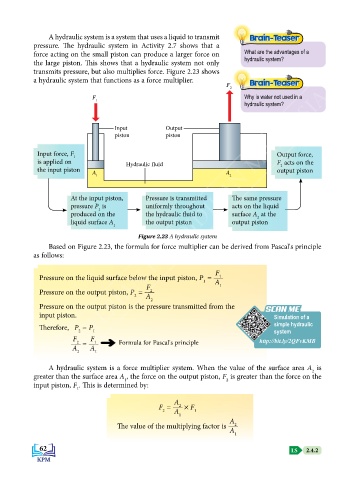
           transmits pressure, but also multiplies force. Figure 2.23 shows
           a hydraulic system that functions as a force multiplier.         Brain-Teaser
                                                                     F
             KEMENTERIAN PENDIDIKAN MALAYSIA
                                                                      2
                             F                                            Why is water not used in a
                              1
                                                                          hydraulic system?

                                   Input           Output
                                   piston          piston

            Input force, F                                                          Output force,
                       1
            is applied on              Hydraulic fluid                              F  acts on the
                                                                                     2
            the input piston                                                        output piston
                             A                                       A
                              1                                       2
                      At the input piston,   Pressure is transmitted   The same pressure
                      pressure P  is         uniformly throughout      acts on the liquid
                               1
                      produced on the        the hydraulic fluid to    surface A  at the
                                                                              2
                      liquid surface A       the output piston         output piston
                                   1
                                          Figure 2.23 A hydraulic system
                Based on Figure 2.23, the formula for force multiplier can be derived from Pascal's principle
           as follows:

                                                                  F
             Pressure on the liquid surface below the input piston, P  =  A 1
                                                              1
                                             F                     1
             Pressure on the output piston, P  =   A 2
                                         2
                                              2
             Pressure on the output piston is the pressure transmitted from the   SCAN ME
                                                                                 SCAN ME
             input piston.                                                         Simulation of a
             Therefore,  P  = P 1                                                  simple hydraulic
                                                                                   system
                         2
                       F    F                                                  http://bit.ly/2QFvKMB
                        2   =   1    Formula for Pascal's principle
                       A 2  A 1

                A hydraulic system is a force multiplier system. When the value of the surface area  A  is
                                                                                               2
           greater than the surface area A , the force on the output piston, F  is greater than the force on the
                                      1
                                                                     2
           input piston, F . This is determined by:
                        1
                                                     A
                                                 F  =   2  µ F
                                                  2  A 1   1
                                                                      A
                                    The value of the multiplying factor is   2
                                                                      A
                                                                       1
             62                                                                         LS   2.4.2

