


Page 45 - DnD_5e_Players_Handbook_(BnW_OCR)
P. 45
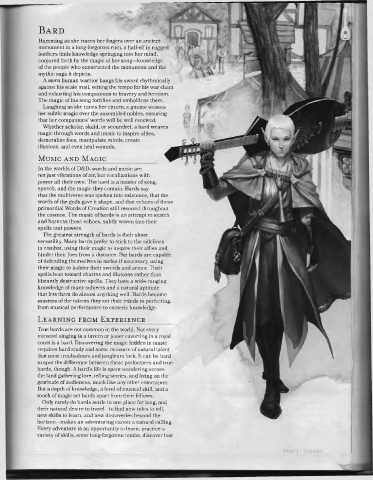
Ba r d
              Humming as she traces her fingers over an ancient
              monument in a long-forgotten ruin, a half-elf in rugged
              leathers finds knowledge springing into her mind,
              conjured forth by the magic of her song—knowledge
              of the people who constructed the monument and the
              mythic saga it depicts.
               A stern human warrior bangs his sword rhythmically
              against his scale mail, setting the tempo for his war chant
              and exhorting his com panions to bravery and heroism.
              The magic of his song fortifies and em boldens them.
               Laughing as she tunes her cittern, a gnom e weaves
              her subtle magic over the assem bled nobles, ensuring
              that her com panions’ words will be well received.
               W hether scholar, skald, or scoundrel, a bard weaves
              magic through w ords and music to inspire allies,
              dem oralize foes, manipulate minds, create
              illusions, and even heal wounds.

              M u s i c   a n d   M a g i c
              In the worlds of D&D, w ords and music are
              not just vibrations of air, but vocalizations with
              power all their own. The bard is a master of song,
              speech, and the m agic they contain. Bards say
              that the multiverse w as spoken into existence, that the
              words o f the gods gave it shape, and that echoes of these
              primordial W ords o f Creation still resound throughout
              the cosm os. The music of bards is an attempt to snatch
              and harness those echoes, subtly woven into their
              spells and powers.
               The greatest strength of bards is their sheer
              versatility. Many bards prefer to stick to the sidelines
              in combat, using their magic to inspire their allies and
              hinder their foes from a distance. But bards are capable
              of defending themselves in melee if necessary, using
              their m agic to bolster their sw ords and armor. Their
              spells lean toward charm s and illusions rather than
              blatantly destructive spells. They have a wide-ranging
              knowledge of many subjects and a natural aptitude
              that lets them do almost anything well. Bards becom e
              masters of the talents they set their minds to perfecting,
              from musical perform ance to esoteric knowledge.
              L e a r n i n g   f r o m   E x p e r i e n c e
              True bards are not com m on in the world. Not every
              minstrel singing in a tavern or jester cavorting in a royal
              court is a bard. Discovering the magic hidden in music
              requires hard study and som e measure of natural talent
             that most troubadours and jongleurs lack. It can be hard
             to spot the difference between these perform ers and true
             bards, though. A bard’s life is spent wandering across
             the land gathering lore, telling stories, and living on the
             gratitude of audiences, much like any other entertainer.
             But a depth of knowledge, a level of musical skill, and a
             touch of magic set bards apart from their fellows.
               Only rarely do bards settle in one place for long, and
             their natural desire to travel—to find new tales to tell,
             new skills to learn, and new discoveries beyond the
             horizon—makes an adventuring career a natural calling.
             Every adventure is an opportunity to learn, practice a
             variety of skills, enter long-forgotten tombs, discover lost

