


Page 32 - BULETIN MAGAZINE baru
P. 32
ARTIKEL PELAJAR JABATAN
       REKABENTUK KOMUNIKASI DAN
                         VISUAL


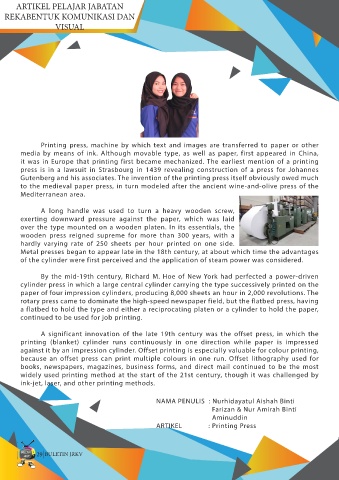
                    Printing press, machine by which text and images are transferred to paper or other
            media by means of ink. Although movable type, as well as paper, first appeared in China,
            it  was  in Europe  that printing first  became mechanized. The earliest mention  of a printing
            press is in a lawsuit in Strasbourg in 1439 revealing construction of a press for Johannes
            Gutenberg and his associates. The invention of the printing press itself obviously owed much
            to the medieval paper press, in turn modeled after the ancient wine-and-olive press of the
            Mediterranean area.


                    A long handle was used to turn a heavy wooden screw,
            exerting downward  pressure against the paper, which  was laid
            over the type mounted on a wooden platen. In its essentials, the
            wooden press reigned supreme for more than 300 years, with a
            hardly varying rate of 250 sheets per hour printed on one side.
            Metal presses began to appear late in the 18th century, at about which time the advantages
            of the cylinder were first perceived and the application of steam power was considered.

                    By the mid-19th century, Richard M. Hoe of New York had perfected a power-driven
            cylinder press in which a large central cylinder carrying the type successively printed on the
            paper of four impression cylinders, producing 8,000 sheets an hour in 2,000 revolutions. The
            rotary press came to dominate the high-speed newspaper field, but the flatbed press, having
            a flatbed to hold the type and either a reciprocating platen or a cylinder to hold the paper,
            continued to be used for job printing.


                    A significant innovation of the late 19th century was the offset press, in which the
            printing (blanket) cylinder runs continuously in one direction while paper is impressed
            against it by an impression cylinder. Offset printing is especially valuable for colour printing,
            because  an  offset  press  can  print  multiple  colours  in  one  run.  Offset  lithography  used  for
            books, newspapers, magazines, business forms, and direct mail continued to be the most
            widely used printing method at the start of the 21st century, though it was challenged by
            ink-jet, laser, and other printing methods.


                                                            NAMA PENULIS  : Nurhidayatul Aishah Binti
                                                                                      Farizan & Nur Amirah Binti
                                                                                  Aminuddin
                                                            ARTIKEL             : Printing Press


                A BULETIN JRKV
                  29 BULETIN JRKV

