


Page 114 - Critical Care Nursing Demystified
P. 114
Chapter 3  CARE OF THE PATIENT WITH CRITICAL CARDIAC AND VASCULAR NEEDS        99


                                 Patients who cannot tolerate exercise may be stressed with drug-induced
                               alternatives, which will also increase the oxygen demands and workload to the
                               heart. Examples of pharmacological agents include adenosine, dipyridamole, or
                               dobutamine.
                                 Whichever stress test modalities are used, visual imaging will identify isch-
                               emic dysfunctions of the myocardium. Such results may indicate a need for
                               further care such as a cardiac catheterization to determine the patency of the
                               coronary arteries. Balloon angioplasty, arterial stent insertion, or even coronary
                               artery bypass surgery might be further recommended.


                               Pulmonary Artery Catheter (PAC)
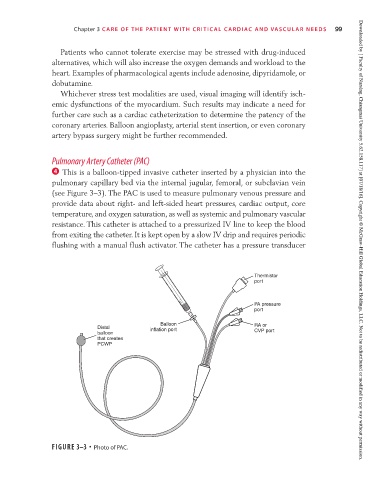
                               4    This is a balloon-tipped invasive catheter inserted by a physician into the
                               pulmonary capillary bed via the internal jugular, femoral, or subclavian vein
                               (see Figure 3–3). The PAC is used to measure pulmonary venous pressure and
                               provide data about right- and left-sided heart pressures, cardiac output, core
                               temperature, and oxygen saturation, as well as systemic and pulmonary vascular
                               resistance. This catheter is attached to a pressurized IV line to keep the blood
                               from exiting the catheter. It is kept open by a slow IV drip and requires periodic
                               flushing with a manual flush activator. The catheter has a pressure transducer       Downloaded by [ Faculty of Nursing, Chiangmai University 5.62.158.117] at [07/18/16]. Copyright © McGraw-Hill Global Education Holdings, LLC. Not to be redistributed or modified in any way without permission.


                                                                                       Thermistor
                                                                                       port


                                                                                       PA pressure
                                                                                       port

                                                             Balloon                   RA or
                                           Distal         inflation port
                                           balloon                                     CVP port
                                           that creates
                                           PCWP


                               FIGURE 3–3  •  Photo of PAC.

