


Page 115 - Critical Care Nursing Demystified
P. 115
100        CRITICAL CARE NURSING  DeMYSTIFIED


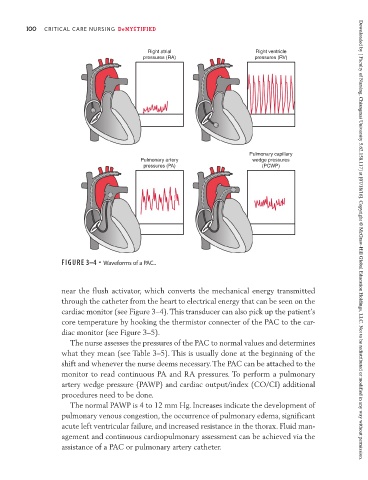
                                                    Right atrial                   Right ventricle
                                                   pressures (RA)                 pressures (RV)


                                                                                 Pulmonary capillary
                                                  Pulmonary artery                wedge pressures
                                                   pressures (PA)                   (PCWP)


                            FIGURE 3–4  •  Waveforms of a PAC..                                                 Downloaded by [ Faculty of Nursing, Chiangmai University 5.62.158.117] at [07/18/16]. Copyright © McGraw-Hill Global Education Holdings, LLC. Not to be redistributed or modified in any way without permission.


                            near the flush activator, which converts the mechanical energy transmitted
                            through the catheter from the heart to electrical energy that can be seen on the
                            cardiac monitor (see Figure 3–4). This transducer can also pick up the patient’s
                            core temperature by hooking the thermistor connecter of the PAC to the car-
                            diac monitor (see Figure 3–5).
                               The nurse assesses the pressures of the PAC to normal values and determines
                            what they mean (see Table 3–5). This is usually done at the beginning of the
                            shift and whenever the nurse deems necessary. The PAC can be attached to the
                            monitor to read continuous PA and RA pressures. To perform a pulmonary
                            artery wedge pressure (PAWP) and cardiac output/index (CO/CI) additional
                            procedures need to be done.
                               The normal PAWP is 4 to 12 mm Hg. Increases indicate the development of
                            pulmonary venous congestion, the occurrence of pulmonary edema, significant
                            acute left ventricular failure, and increased resistance in the thorax. Fluid man-
                            agement and continuous cardiopulmonary assessment can be achieved via the
                            assistance of a PAC or pulmonary artery catheter.

