


Page 136 - Critical Care Nursing Demystified
P. 136
Chapter 3  CARE OF THE PATIENT WITH CRITICAL CARDIAC AND VASCULAR NEEDS        121


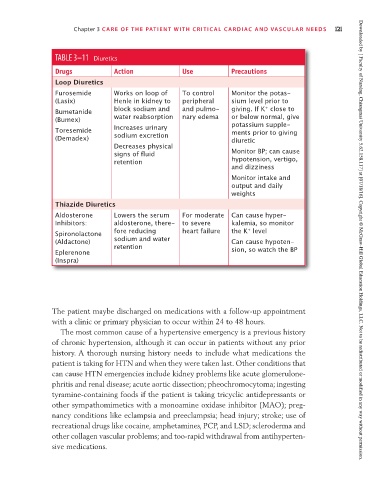
                               TABLE 3–11  Diuretics
                               Drugs            Action             Use           Precautions
                               Loop Diuretics
                               Furosemide       Works on loop of   To control    Monitor the potas-
                               (Lasix)          Henle in kidney to   peripheral   sium level prior to
                                                                                          +
                               Bumetanide       block sodium and   and pulmo-    giving. If K  close to
                               (Bumex)          water reabsorption  nary edema   or below normal, give
                                                                                 potassium supple-
                               Toresemide       Increases urinary                ments prior to giving
                               (Demadex)        sodium excretion                 diuretic
                                                Decreases physical
                                                signs of fluid                   Monitor BP; can cause
                                                retention                        hypotension, vertigo,
                                                                                 and dizziness
                                                                                 Monitor intake and
                                                                                 output and daily
                                                                                 weights
                               Thiazide Diuretics
                               Aldosterone      Lowers the serum   For moderate  Can cause hyper-
                               Inhibitors:      aldosterone, there-  to severe   kalemia, so monitor
                                                                                     +
                               Spironolactone   fore reducing      heart failure  the K  level
                                 (Aldactone)    sodium and water                 Can cause hypoten-                 Downloaded by [ Faculty of Nursing, Chiangmai University 5.62.158.117] at [07/18/16]. Copyright © McGraw-Hill Global Education Holdings, LLC. Not to be redistributed or modified in any way without permission.
                                                retention
                               Eplerenone                                        sion, so watch the BP
                               (Inspra)


                               The patient maybe discharged on medications with a follow-up appointment
                               with a clinic or primary physician to occur within 24 to 48 hours.
                                 The most common cause of a hypertensive emergency is a previous history
                               of chronic hypertension, although it can occur in patients without any prior
                               history. A thorough nursing history needs to include what medications the
                               patient is taking for HTN and when they were taken last. Other conditions that
                               can cause HTN emergencies include kidney problems like acute glomerulone-
                               phritis and renal disease; acute aortic dissection; pheochromocytoma; ingesting
                               tyramine-containing foods if the patient is taking tricyclic antidepressants or
                               other sympathomimetics with a monoamine oxidase inhibitor (MAO); preg-
                               nancy conditions like eclampsia and preeclampsia; head injury; stroke; use of
                               recreational drugs like cocaine, amphetamines, PCP, and LSD; scleroderma and
                               other collagen vascular problems; and too-rapid withdrawal from antihyperten-
                               sive medications.

