


Page 139 - Critical Care Nursing Demystified
P. 139
124        CRITICAL CARE NURSING  DeMYSTIFIED


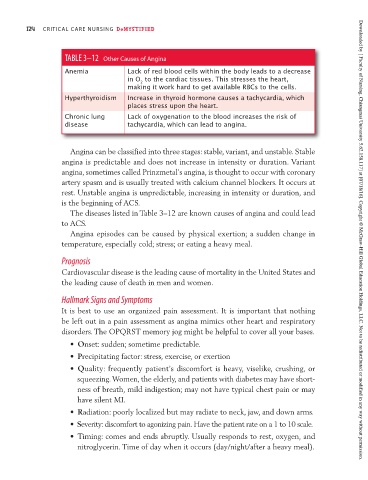
                             TABLE 3–12  Other Causes of Angina
                             Anemia            Lack of red blood cells within the body leads to a decrease
                                               in O  to the cardiac tissues. This stresses the heart,
                                                  2
                                                 making it work hard to get available RBCs to the cells.
                             Hyperthyroidism   Increase in thyroid hormone causes a tachycardia, which
                                               places stress upon the heart.
                             Chronic lung      Lack of oxygenation to the blood increases the risk of
                               disease         tachycardia, which can lead to angina.


                               Angina can be classified into three stages: stable, variant, and unstable. Stable
                            angina is predictable and does not increase in intensity or duration. Variant
                            angina, sometimes called Prinzmetal’s angina, is thought to occur with coronary
                            artery spasm and is usually treated with calcium channel blockers. It occurs at
                            rest. Unstable angina is unpredictable, increasing in intensity or duration, and
                            is the beginning of ACS.
                               The diseases listed in Table 3–12 are known causes of angina and could lead
                            to ACS.
                               Angina episodes can be caused by physical exertion; a sudden change in
                            temperature, especially cold; stress; or eating a heavy meal.                       Downloaded by [ Faculty of Nursing, Chiangmai University 5.62.158.117] at [07/18/16]. Copyright © McGraw-Hill Global Education Holdings, LLC. Not to be redistributed or modified in any way without permission.
                            Prognosis
                            Cardiovascular disease is the leading cause of mortality in the United States and
                            the leading cause of death in men and women.

                            Hallmark Signs and Symptoms
                            It is best to use an organized pain assessment. It is important that nothing
                            be left out in a pain assessment as angina mimics other heart and respiratory
                            disorders. The OPQRST memory jog might be helpful to cover all your bases.
                               •   Onset: sudden; sometime predictable.
                               •   Precipitating factor: stress, exercise, or exertion
                               •   Quality: frequently patient’s discomfort is heavy, viselike, crushing, or
                                 squeezing. Women, the elderly, and patients with diabetes may have short-
                                 ness of breath, mild indigestion; may not have typical chest pain or may
                                 have silent MI.
                               •   Radiation: poorly localized but may radiate to neck, jaw, and down arms.
                               •   Severity: discomfort to agonizing pain. Have the patient rate on a 1 to 10 scale.
                               •   Timing: comes and ends abruptly. Usually responds to rest, oxygen, and
                                 nitroglycerin. Time of day when it occurs (day/night/after a heavy meal).

