


Page 184 - Critical Care Nursing Demystified
P. 184
Chapter 4  CARE OF THE PATIENT WITH CRITICAL CARDIAC RHY THM DISTURBANCE NEEDS        169


                               TABLE 4–2  Types of Monitoring Systems
                               System          What It Does              Where It Is Used
                               Hardwire        Patient is physically     ICU/CCU/ECU/PACU and OR
                               monitoring      attached to a cable that   First responders; ALS units
                                               leads to a monitor
                                               Little mobility; patient can
                                               be assisted OOB
                               Telemetry       Small transmitting unit on   Cardiac and intensive care
                                               chest                     recovery units (post OHS); less
                                               Patient more mobile; can   intensive care needed
                                               ambulate                  Cardiac stress testing
                                                                         Cardiac rehabilitation
                               Holter monitor  Continuously monitors and  Capture stubborn, periodic
                                               records patientʼs heart   rhythm changes while patient
                                               rhythm while patient wears  resumes normal activity
                                               it over 24–72-hour period.  Patient wears like a larger iPod;
                                                                         cardiologist surveyʼs any
                                                                         changes in patient rhythm
                                                                         with patient diary
                                                                         Patient keeps diary of signs/
                                                                         symptoms/events                            Downloaded by [ Faculty of Nursing, Chiangmai University 5.62.158.117] at [07/18/16]. Copyright © McGraw-Hill Global Education Holdings, LLC. Not to be redistributed or modified in any way without permission.


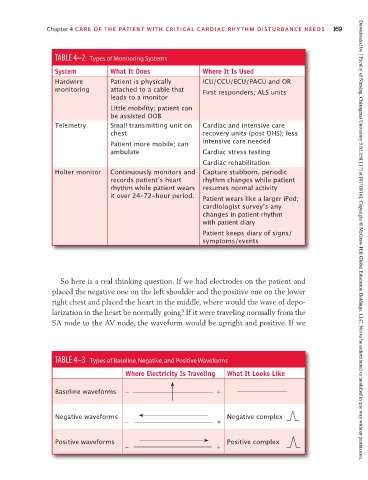
                                 So here is a real thinking question. If we had electrodes on the patient and
                               placed the negative one on the left shoulder and the positive one on the lower
                               right chest and placed the heart in the middle, where would the wave of depo-
                               larization in the heart be normally going? If it were traveling normally from the
                               SA node to the AV node, the waveform would be upright and positive. If we


                               TABLE 4–3  Types of Baseline, Negative, and Positive Waveforms
                                                   Where Electricity Is Traveling  What It Looks Like

                               Baseline waveforms  −                         +


                               Negative waveforms                              Negative complex
                                                   −                         +

                               Positive waveforms                              Positive complex
                                                   −                         +

