


Page 209 - Critical Care Nursing Demystified
P. 209
194        CRITICAL CARE NURSING  DeMYSTIFIED


                             TABLE 4–6  Types of Pacers
                                               Description      Placement         Invasive?
                             Temporary Pacers
                             Transcutaneous    Large electrode   Anterior and pos-  No: Used in emer-
                                               pads attached to   terior chest    gency until more
                                               chest in anterior                  invasive mode/
                                               and posterior                      permanent type of
                                               position                           pacing can be
                                                                                  instituted. Acti-
                                                                                  vates heart from
                                                                                  electrical stimulus
                                                                                  from outside to
                                                                                  inside chest.
                             Epicardial        Wires that exit   Above mediastinal  Yes: Placed on the
                                               the chest inserted  chest tubes    atria, ventricles
                                               surgically                         during OHS and
                                                                                  removed before
                                                                                  discharge.
                             Transvenous       Catheter inserted  Inserted through   Yes: Usually
                                               venously. Distal   vein (subclavian,   inserted through
                                               wires attached to   antecubital) or a   a central line
                                               positive and neg-  part of a PA cath-  access site but           Downloaded by [ Faculty of Nursing, Chiangmai University 5.62.158.117] at [07/18/16]. Copyright © McGraw-Hill Global Education Holdings, LLC. Not to be redistributed or modified in any way without permission.
                                               ative pole of    eter that can pace   can be inserted
                                               external genera-  the heart from   peripherally.
                                               tor box.         inside the right
                                                                atrium or right
                                                                ventricle
                             Permanent
                             Permanent         Implanted        Near the right    Yes: Wires passed
                                               through surgical   pectoral muscle   through a vein
                                               incision done    (subclavian space)  and attached to a
                                               under local anes-                  generator box.
                                               thesia


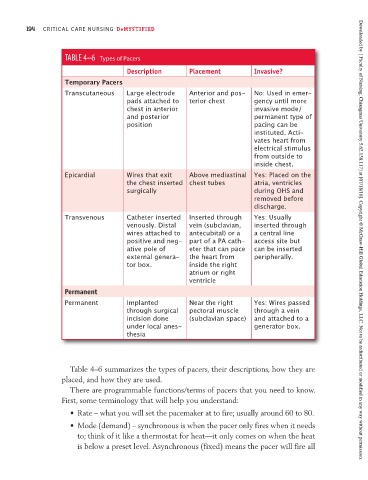
                               Table 4–6 summarizes the types of pacers, their descriptions, how they are
                            placed, and how they are used.
                               There are programmable functions/terms of pacers that you need to know.
                            First, some terminology that will help you understand:
                               •   Rate – what you will set the pacemaker at to fire; usually around 60 to 80.
                               •   Mode (demand) – synchronous is when the pacer only fires when it needs
                                 to; think of it like a thermostat for heat—it only comes on when the heat
                                 is below a preset level. Asynchronous (fixed) means the pacer will fire all

