


Page 210 - Critical Care Nursing Demystified
P. 210
Chapter 4  CARE OF THE PATIENT WITH CRITICAL CARDIAC RHY THM DISTURBANCE NEEDS        195


                                   the time, so make sure the patient has no underlying rhythm that comes
                                   through.
                                 •   Capture – when the pacer causes the heart to beat; usually signified by a
                                   pacer spike and the chamber paced (i.e., pacer spike and P wave for atrial
                                   pacing; pacer spike and R wave for ventricular pacing).
                                 •   Threshold – the minimum amount of voltage (mA) needed to consistently
                                   capture the heart.
                                 •   mA – amount of electricity needed to capture the heart.


                                 NURSING ALERT

                                 An asynchronous pacing mode is only used when there is no chance that the pa-
                                 tient’s own rhythm will break through and compete with the pacer. If the pacer fires

                                 on the patient’s own T wave, it could create electrical chaos and lead to ventricular
                                 tachycardia or fibrillation.


                               The Pacer Codes                                                                      Downloaded by [ Faculty of Nursing, Chiangmai University 5.62.158.117] at [07/18/16]. Copyright © McGraw-Hill Global Education Holdings, LLC. Not to be redistributed or modified in any way without permission.
                               The critical care nurse needs to know about the five pacing codes that tell
                               about different pacer functions. These are divided into chamber paced, cham-
                               ber sensed, response to sensed event, rate modulation, and multisite pacing.
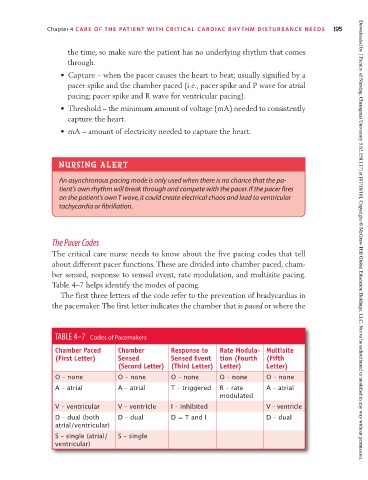
                               Table 4–7 helps identify the modes of pacing.
                                 The first three letters of the code refer to the prevention of bradycardias in
                               the pacemaker. The first letter indicates the chamber that is paced or where the


                               TABLE 4–7  Codes of Pacemakers
                               Chamber Paced     Chamber        Response to   Rate Modula- Multisite
                               (First Letter)    Sensed         Sensed Event  tion (Fourth  (Fifth
                                                 (Second Letter) (Third Letter) Letter)   Letter)
                               O – none          O – none       O – none     O – none     O – none
                               A – atrial        A – atrial     T – triggered  R – rate   A – atrial
                                                                             modulated
                               V – ventricular   V – ventricle  I – inhibited             V – ventricle
                               D – dual (both    D – dual       D = T and I               D – dual
                               atrial/ventricular)
                               S – single (atrial/  S – single
                               ventricular)

