


Page 227 - Critical Care Nursing Demystified
P. 227
212        CRITICAL CARE NURSING  DeMYSTIFIED


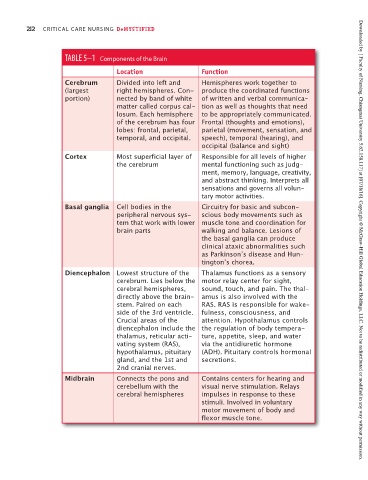
                             TABLE 5–1  Components of the Brain
                                            Location               Function
                             Cerebrum       Divided into left and   Hemispheres work together to
                             (largest       right hemispheres. Con-  produce the coordinated functions
                               portion)     nected by band of white   of written and verbal communica-
                                            matter called corpus cal- tion as well as thoughts that need
                                            losum. Each hemisphere   to be appropriately communicated.
                                            of the cerebrum has four  Frontal (thoughts and emotions),
                                            lobes: frontal, parietal,   parietal (movement, sensation, and
                                            temporal, and occipital.  speech), temporal (hearing), and
                                                                   occipital (balance and sight)
                             Cortex         Most superficial layer of   Responsible for all levels of higher
                                            the cerebrum           mental functioning such as judg-
                                                                   ment, memory, language, creativity,
                                                                   and abstract thinking. Interprets all
                                                                   sensations and governs all volun-
                                                                   tary motor activities.
                             Basal  ganglia  Cell bodies in the    Circuitry for basic and subcon-
                                            peripheral nervous sys-  scious body movements such as
                                            tem that work with lower  muscle tone and coordination for
                                            brain parts            walking and balance. Lesions of
                                                                   the basal ganglia can produce                Downloaded by [ Faculty of Nursing, Chiangmai University 5.62.158.117] at [07/18/16]. Copyright © McGraw-Hill Global Education Holdings, LLC. Not to be redistributed or modified in any way without permission.
                                                                   clinical ataxic abnormalities such
                                                                   as Parkinsonʼs disease and Hun-
                                                                   tingtonʼs chorea.
                             Diencephalon   Lowest structure of the   Thalamus functions as a sensory
                                            cerebrum. Lies below the  motor relay center for sight,
                                            cerebral hemispheres,   sound, touch, and pain. The thal-
                                            directly above the brain-  amus is also involved with the
                                            stem. Paired on each   RAS. RAS is responsible for wake-
                                            side of the 3rd ventricle.  fulness, consciousness, and
                                            Crucial areas of the   attention. Hypothalamus controls
                                            diencephalon include the  the regulation of body tempera-
                                            thalamus, reticular acti-  ture, appetite, sleep, and water
                                            vating system (RAS),   via the antidiuretic hormone
                                            hypothalamus, pituitary   (ADH). Pituitary controls hormonal
                                            gland, and the 1st and   secretions.
                                            2nd cranial nerves.
                             Midbrain       Connects the pons and   Contains centers for hearing and
                                            cerebellum with the    visual nerve stimulation. Relays
                                            cerebral hemispheres   impulses in response to these
                                                                   stimuli. Involved in voluntary
                                                                   motor movement of body and
                                                                   flexor muscle tone.

