


Page 230 - Critical Care Nursing Demystified
P. 230
Chapter 5  CARE OF THE PATIENT WITH NEUROLOGICAL NEEDS        215


                                 The autonomic or involuntary nervous system (ANS) is also known as the
                               motor division in which motor neurons connect the CNS with smooth muscle
                               and cardiac muscle, as well as the glands and internal organs. The ANS regulates
                               functions of the heart, respiratory, and gastrointestinal activity. The ANS divi-
                               sion includes the sympathetic and parasympathetic branches. Motor fibers are
                               known as efferent fibers that transmit CNS responses to the appropriate organs,
                               muscles, or glands. The transmission of both sensory (afferent) and motor (effer-
                               ent) information in the CNS is conducted by internuncial fibers.
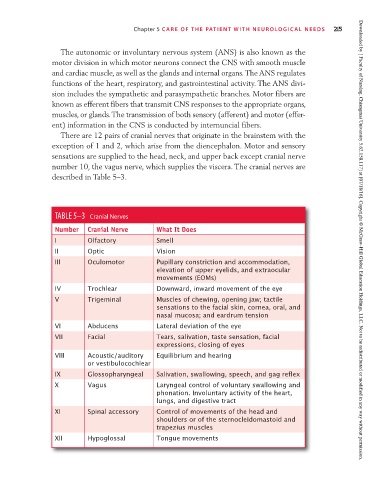
                                 There are 12 pairs of cranial nerves that originate in the brainstem with the
                               exception of 1 and 2, which arise from the diencephalon. Motor and sensory
                               sensations are supplied to the head, neck, and upper back except cranial nerve
                               number 10, the vagus nerve, which supplies the viscera. The cranial nerves are
                               described in Table 5–3.


                               TABLE 5–3  Cranial Nerves
                               Number    Cranial Nerve      What It Does
                               I         Olfactory          Smell                                                   Downloaded by [ Faculty of Nursing, Chiangmai University 5.62.158.117] at [07/18/16]. Copyright © McGraw-Hill Global Education Holdings, LLC. Not to be redistributed or modified in any way without permission.
                               II        Optic              Vision
                               III       Oculomotor         Pupillary constriction and accommodation,
                                                            elevation of upper eyelids, and extraocular
                                                            movements (EOMs)
                               IV        Trochlear          Downward, inward movement of the eye
                               V         Trigeminal         Muscles of chewing, opening jaw; tactile
                                                              sensations to the facial skin, cornea, oral, and
                                                            nasal mucosa; and eardrum tension
                               VI        Abducens           Lateral deviation of the eye
                               VII       Facial             Tears, salivation, taste sensation, facial
                                                            expressions, closing of eyes
                               VIII      Acoustic/auditory   Equilibrium and hearing
                                         or vestibulocochlear
                               IX        Glossopharyngeal   Salivation, swallowing, speech, and gag reflex
                               X         Vagus              Laryngeal control of voluntary swallowing and
                                                            phonation. Involuntary activity of the heart,
                                                            lungs, and digestive tract
                               XI        Spinal accessory   Control of movements of the head and
                                                              shoulders or of the sternocleidomastoid and
                                                            trapezius muscles
                               XII       Hypoglossal        Tongue movements

