


Page 243 - Critical Care Nursing Demystified
P. 243
NURSING ALERT


                              If reflexes tend to be hyperactive, the nurse should test for ankle clonus by supporting

                              the patient’s knee in a slightly flexed position. With the other hand, the nurse should

                              dorsiflex the foot and keep it in a flexed position to minimize hyperactivity of the af-

                              fected area. There should be no movement of the foot.
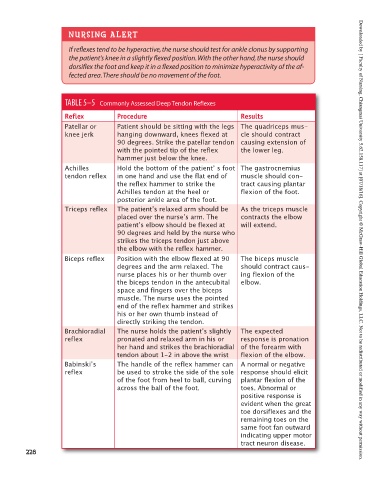
                             TABLE 5–5  Commonly Assessed Deep Tendon Reflexes

                             Reflex         Procedure                         Results
                             Patellar or    Patient should be sitting with the legs  The quadriceps mus-
                             knee jerk      hanging downward, knees flexed at   cle should contract
                                            90 degrees. Strike the patellar tendon  causing extension of
                                            with the pointed tip of the reflex   the lower leg.
                                            hammer just below the knee.
                             Achilles       Hold the bottom of the patientʼ s foot  The gastrocnemius
                             tendon reflex  in one hand and use the flat end of   muscle should con-
                                            the reflex hammer to strike the   tract causing plantar
                                            Achilles tendon at the heel or    flexion of the foot.
                                            posterior ankle area of the foot.
                             Triceps reflex   The patientʼs relaxed arm should be   As the triceps muscle
                                            placed over the nurseʼs arm. The   contracts the elbow
                                            patientʼs elbow should be flexed at   will extend.
                                            90 degrees and held by the nurse who
                                            strikes the triceps tendon just above                               Downloaded by [ Faculty of Nursing, Chiangmai University 5.62.158.117] at [07/18/16]. Copyright © McGraw-Hill Global Education Holdings, LLC. Not to be redistributed or modified in any way without permission.
                                            the elbow with the reflex hammer.
                             Biceps reflex   Position with the elbow flexed at 90   The biceps muscle
                                            degrees and the arm relaxed. The   should contract caus-
                                            nurse places his or her thumb over   ing flexion of the
                                            the biceps tendon in the antecubital   elbow.
                                            space and fingers over the biceps
                                            muscle. The nurse uses the pointed
                                            end of the reflex hammer and strikes
                                            his or her own thumb instead of
                                            directly striking the tendon.
                             Brachioradial   The nurse holds the patientʼs slightly   The expected
                             reflex         pronated and relaxed arm in his or   response is pronation
                                            her hand and strikes the brachioradial  of the forearm with
                                            tendon about 1-2 in above the wrist  flexion of the elbow.
                             Babinskiʼs     The handle of the reflex hammer can  A normal or negative
                             reflex         be used to stroke the side of the sole  response should elicit
                                            of the foot from heel to ball, curving   plantar flexion of the
                                            across the ball of the foot.      toes. Abnormal or
                                                                              positive response is
                                                                              evident when the great
                                                                              toe dorsiflexes and the
                                                                              remaining toes on the
                                                                              same foot fan outward
                                                                              indicating upper motor
                                                                              tract neuron disease.
                  228

