


Page 248 - Critical Care Nursing Demystified
P. 248
Chapter 5  CARE OF THE PATIENT WITH NEUROLOGICAL NEEDS        233


                               performed on patients with pacemakers, surgical clips, and prosthetic implants
                               made of ferrous metal, including life support mechanical ventilators.


                               Intracranial Pressure (ICP) Monitoring

                               To maintain a normal ICP, the following three brain components need to be
                               regulated to maintain a fixed intracranial volume. As long as the total intracra-
                               nial volume remains the same, ICP remains constant at 0 to 15 mm Hg = nor-
                               mal. Parts that compose the total intracranial volume are CBF or cerebral blood
                               flow = 3% to 10%, cerebrospinal fluid circulation = 8% to 12%, and intravascu-
                               lar plus the volume of semisolid brain tissue, which is more than 80% H O.
                                                                                                2
                                 A constant perfusion pressure to the brain is needed to supply oxygen and nutri-
                               ents to the cerebral neurons and to prevent excessive pressure leading to brain
                               herniation. In order to do this, cerebral perfusion pressures need to be monitored
                               via an intracranial monitoring device. An intracranial monitoring device records the
                               ICP, which is used to calculate the cerebral perfusion pressure (CPP).
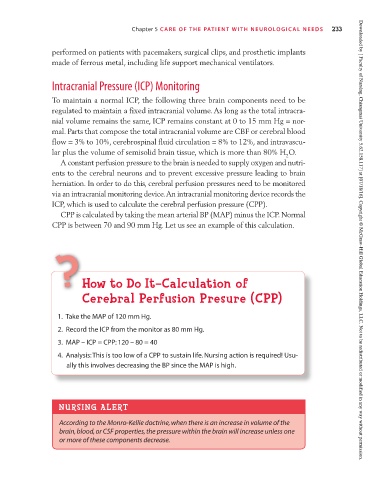
                                 CPP is calculated by taking the mean arterial BP (MAP) minus the ICP. Normal
                               CPP is between 70 and 90 mm Hg. Let us see an example of this calculation.           Downloaded by [ Faculty of Nursing, Chiangmai University 5.62.158.117] at [07/18/16]. Copyright © McGraw-Hill Global Education Holdings, LLC. Not to be redistributed or modified in any way without permission.


                                       H ?  How to Do It—Calculation of


                                           w t
                                                          t—C
                                         o
                                                      o I
                                                                  l
                                                                   c
                                                                a
                                                o D
                                       Cerebral Perfusion Presure (CPP)
                                       Cerebral Perfusio
                                1.  Take the MAP of 120 mm Hg. .
                                     e the MAP o
                                1.
                                   ak
                                                 120 mm H

                                                         g
                                               f
                                  T
                                2.  Record the ICP from the monitor as 80 mm Hg.
                                2.  Rec o r d   the  ICP  f r om the monit or as 80  m
                                                  12
                                                   0
                                                         = 4
                                                           0
                                                     –
                                                      80

                                   MAP – I
                                3.  MAP – ICP = CPP: 120 – 80 = 40
                                3.
                                         C
                                                :
                                              PP
                                             C
                                          P =
                                4.   Analysis: This is too low of a CPP to sustain life. Nursing action is required! Usu-
                                   ally this involves decreasing the BP since the MAP is high.
                                 NURSING ALERT
                                 According to the Monro-Kellie doctrine, when there is an increase in volume of the
                                 brain, blood, or CSF properties, the pressure within the brain will increase unless one
                                 or more of these components decrease.

