


Page 249 - Critical Care Nursing Demystified
P. 249
234        CRITICAL CARE NURSING  DeMYSTIFIED


                            Intracranial Pressure Monitoring Devices

                            Before the patient can be attached to a monitoring device to monitor his or her
                            ICP, a measuring device must be inserted by a neurologist. These can be inserted
                            into the intraventricular, subarachnoid, or epidural spaces or into the brain
                            parenchyma itself. Following is a brief description of each site.


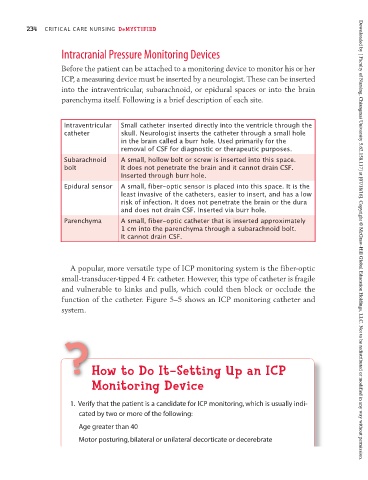
                             Intraventricular   Small catheter inserted directly into the ventricle through the
                               catheter      skull. Neurologist inserts the catheter through a small hole
                                             in the brain called a burr hole. Used primarily for the
                                             removal of CSF for diagnostic or therapeutic purposes.
                             Subarachnoid    A small, hollow bolt or screw is inserted into this space.
                             bolt            It does not penetrate the brain and it cannot drain CSF.
                                             Inserted through burr hole.
                             Epidural sensor   A small, fiber-optic sensor is placed into this space. It is the
                                             least invasive of the catheters, easier to insert, and has a low
                                             risk of infection. It does not penetrate the brain or the dura
                                             and does not drain CSF. Inserted via burr hole.
                             Parenchyma      A small, fiber-optic catheter that is inserted approximately
                                             1 cm into the parenchyma through a subarachnoid bolt.
                                             It cannot drain CSF.                                               Downloaded by [ Faculty of Nursing, Chiangmai University 5.62.158.117] at [07/18/16]. Copyright © McGraw-Hill Global Education Holdings, LLC. Not to be redistributed or modified in any way without permission.


                               A popular, more versatile type of ICP monitoring system is the fiber-optic
                            small-transducer-tipped 4 Fr. catheter. However, this type of catheter is fragile
                            and vulnerable to kinks and pulls, which could then block or occlude the
                            function of the catheter. Figure 5–5 shows an ICP monitoring catheter and
                            system.


                                     H ?  How to Do It—Setting Up an ICP


                                         w t
                                       o
                                                             S
                                                              e
                                                                t
                                               o D
                                                    o I
                                                         t—
                                     Monitoring Device
                                     Monitoring Devic
                                                                o
                                  e
                                 V

                                1.   Verify that the patient is a candidate for ICP monitoring, which is usually indi-
                                   rif
                                     y
                                       that the patient is a candidat
                                                                 r
                                                              e f
                               1.
                                 cated by two or more of the following:
                                 cat e d b y  tw o or mor e  o f  the  f ollo wing :
                                 Age greater than 40
                                A g e  g r e at er than 40
                                                            l
                                                                l
                                                                 d
                                                             t
                                 M
                                                bi
                                    t
                                          t
                                            i
                                                      l
                                                           i
                                 Motor posturing, bilateral or unilateral decorticate or decerebrate
                                                 l
                                                   t

