


Page 251 - Critical Care Nursing Demystified
P. 251
236        CRITICAL CARE NURSING  DeMYSTIFIED


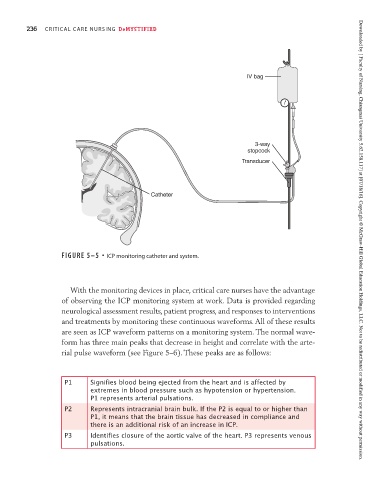
                                                                                IV bag


                                                                                  3-way
                                                                                stopcock
                                                                               Transducer


                                                     Catheter


                            FIGURE 5–5  •  ICP monitoring catheter and system.                                  Downloaded by [ Faculty of Nursing, Chiangmai University 5.62.158.117] at [07/18/16]. Copyright © McGraw-Hill Global Education Holdings, LLC. Not to be redistributed or modified in any way without permission.


                               With the monitoring devices in place, critical care nurses have the advantage
                            of observing the ICP monitoring system at work. Data is provided regarding
                            neurological assessment results, patient progress, and responses to interventions
                            and treatments by monitoring these continuous waveforms. All of these results
                            are seen as ICP waveform patterns on a monitoring system. The normal wave-
                            form has three main peaks that decrease in height and correlate with the arte-
                            rial pulse waveform (see Figure 5–6). These peaks are as follows:


                             P1     Signifies blood being ejected from the heart and is affected by
                                    extremes in blood pressure such as hypotension or hypertension.
                                    P1 represents arterial pulsations.
                             P2     Represents intracranial brain bulk. If the P2 is equal to or higher than
                                    P1, it means that the brain tissue has decreased in compliance and
                                    there is an additional risk of an increase in ICP.
                             P3     Identifies closure of the aortic valve of the heart. P3 represents venous
                                    pulsations.

