


Page 284 - Critical Care Nursing Demystified
P. 284
Chapter 6  CARE OF THE  TRAUMATIZED PATIENT        269


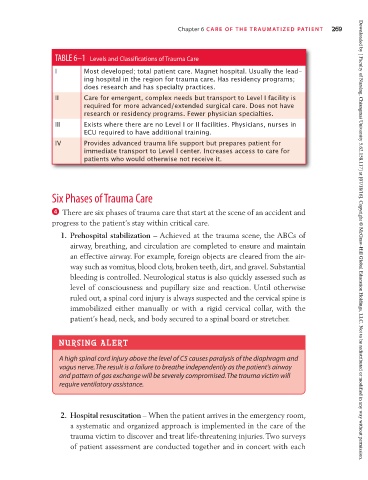
                               TABLE 6–1  Levels and Classifications of Trauma Care
                               I        Most developed; total patient care. Magnet hospital. Usually the lead-
                                        ing hospital in the region for trauma care. Has residency programs;
                                        does research and has specialty practices.
                               II       Care for emergent, complex needs but transport to Level I facility is
                                        required for more advanced/extended surgical care. Does not have
                                        research or residency programs. Fewer physician specialties.
                               III      Exists where there are no Level I or II facilities. Physicians, nurses in
                                        ECU required to have additional training.
                               IV       Provides advanced trauma life support but prepares patient for
                                        immediate transport to Level I center. Increases access to care for
                                        patients who would otherwise not receive it.


                               Six Phases of Trauma Care
                               4    There are six phases of trauma care that start at the scene of an accident and
                               progress to the patient’s stay within critical care.
                                 1.  Prehospital stabilization – Achieved at the trauma scene, the ABCs of
                                    airway, breathing, and circulation are completed to ensure and maintain         Downloaded by [ Faculty of Nursing, Chiangmai University 5.62.158.117] at [07/18/16]. Copyright © McGraw-Hill Global Education Holdings, LLC. Not to be redistributed or modified in any way without permission.
                                    an effective airway. For example, foreign objects are cleared from the air-
                                    way such as vomitus, blood clots, broken teeth, dirt, and gravel. Substantial
                                    bleeding is controlled. Neurological status is also quickly assessed such as
                                    level of consciousness and pupillary size and reaction. Until otherwise
                                    ruled out, a spinal cord injury is always suspected and the cervical spine is
                                    immobilized either manually or with a rigid cervical collar, with the
                                      patient’s head, neck, and body secured to a spinal board or stretcher.


                                 NURSING ALERT

                                 A high spinal cord injury above the level of C5 causes paralysis of the diaphragm and
                                 vagus nerve. The result is a failure to breathe independently as the patient’s airway
                                 and pattern of gas exchange will be severely compromised. The trauma victim will
                                 require ventilatory assistance.


                                 2.  Hospital resuscitation – When the patient arrives in the emergency room,
                                    a systematic and organized approach is implemented in the care of the
                                    trauma victim to discover and treat life-threatening injuries. Two surveys
                                    of patient assessment are conducted together and in concert with each

