


Page 289 - Critical Care Nursing Demystified
P. 289
274        CRITICAL CARE NURSING  DeMYSTIFIED


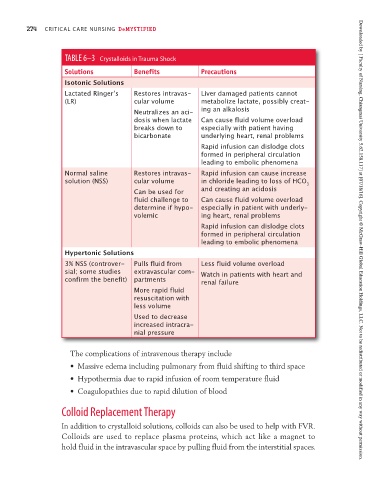
                             TABLE 6–3  Crystalloids in Trauma Shock
                             Solutions           Benefits          Precautions
                             Isotonic Solutions
                             Lactated Ringerʼs   Restores intravas-  Liver damaged patients cannot
                             (LR)                cular volume      metabolize lactate, possibly creat-
                                                 Neutralizes an aci-  ing an alkalosis
                                                 dosis when lactate   Can cause fluid volume  overload
                                                 breaks down to    especially with patient having
                                                 bicarbonate       underlying heart, renal problems
                                                                   Rapid infusion can dislodge clots
                                                                   formed in peripheral  circulation
                                                                   leading to embolic phenomena
                             Normal saline       Restores intravas-  Rapid infusion can cause increase
                               solution (NSS)    cular volume      in chloride leading to loss of HCO
                                                                                                 3
                                                 Can be used for   and creating an acidosis
                                                 fluid challenge to   Can cause fluid volume overload
                                                 determine if hypo-  especially in patient with underly-
                                                 volemic           ing heart, renal problems
                                                                   Rapid infusion can dislodge clots
                                                                   formed in peripheral  circulation
                                                                   leading to embolic phenomena                 Downloaded by [ Faculty of Nursing, Chiangmai University 5.62.158.117] at [07/18/16]. Copyright © McGraw-Hill Global Education Holdings, LLC. Not to be redistributed or modified in any way without permission.
                             Hypertonic Solutions
                             3% NSS (controver-  Pulls fluid from   Less fluid volume overload
                             sial; some studies   extravascular com-  Watch in patients with heart and
                             confirm the benefit)  partments       renal failure
                                                 More rapid fluid
                                                 resuscitation with
                                                 less volume
                                                 Used to decrease
                                                 increased intracra-
                                                 nial pressure


                               The complications of intravenous therapy include
                               •   Massive edema including pulmonary from fluid shifting to third space
                               •   Hypothermia due to rapid infusion of room temperature fluid
                               •   Coagulopathies due to rapid dilution of blood


                            Colloid Replacement Therapy
                            In addition to crystalloid solutions, colloids can also be used to help with FVR.
                            Colloids are used to replace plasma proteins, which act like a magnet to
                            hold fluid in the intravascular space by pulling fluid from the interstitial spaces.

