


Page 288 - Critical Care Nursing Demystified
P. 288
Chapter 6  CARE OF THE  TRAUMATIZED PATIENT        273


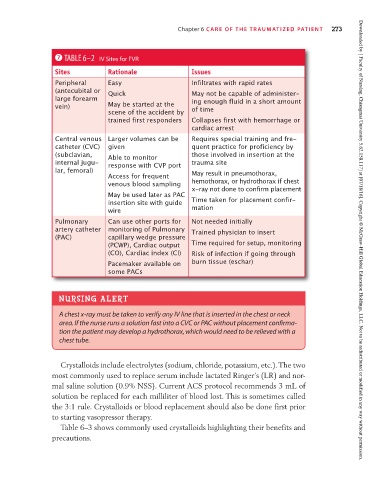
                                7  TABLE 6–2  IV Sites for FVR

                               Sites          Rationale               Issues
                               Peripheral     Easy                    Infiltrates with rapid rates
                               (antecubital or   Quick                May not be capable of administer-
                               large forearm                          ing enough fluid in a short amount
                               vein)          May be started at the   of time
                                              scene of the accident by
                                              trained first responders  Collapses first with hemorrhage or
                                                                      cardiac arrest
                               Central venous  Larger volumes can be   Requires special training and fre-
                               catheter (CVC)  given                  quent practice for proficiency by
                               (subclavian,   Able to monitor         those involved in insertion at the
                               internal jugu-  response with CVP port  trauma site
                               lar, femoral)                          May result in pneumothorax,
                                              Access for frequent
                                              venous blood sampling   hemothorax, or hydrothorax if chest
                                                                      x-ray not done to confirm placement
                                              May be used later as PAC
                                              insertion site with guide   Time taken for placement confir-
                                              wire                    mation
                               Pulmonary      Can use other ports for   Not needed initially
                               artery catheter  monitoring of Pulmonary   Trained physician to insert
                               (PAC)          capillary wedge pressure
                                              (PCWP), Cardiac output   Time required for setup,  monitoring         Downloaded by [ Faculty of Nursing, Chiangmai University 5.62.158.117] at [07/18/16]. Copyright © McGraw-Hill Global Education Holdings, LLC. Not to be redistributed or modified in any way without permission.
                                              (CO), Cardiac index (CI)  Risk of infection if going through
                                              Pacemaker available on   burn tissue (eschar)
                                              some PACs


                                 NURSING ALERT

                                 A chest x-ray must be taken to verify any IV line that is inserted in the chest or neck
                                 area. If the nurse runs a solution fast into a CVC or PAC without placement confirma-

                                 tion the patient may develop a hydrothorax, which would need to be relieved with a
                                 chest tube.


                                 Crystalloids include electrolytes (sodium, chloride, potassium, etc.). The two
                               most commonly used to replace serum include lactated Ringer’s (LR) and nor-
                               mal saline solution (0.9% NSS). Current ACS protocol recommends 3 mL of
                               solution be replaced for each milliliter of blood lost. This is sometimes called
                               the 3:1 rule. Crystalloids or blood replacement should also be done first prior
                               to starting vasopressor therapy.
                                 Table 6–3 shows commonly used crystalloids highlighting their benefits and
                               precautions.

