


Page 314 - Critical Care Nursing Demystified
P. 314
Chapter 6  CARE OF THE  TRAUMATIZED PATIENT        299


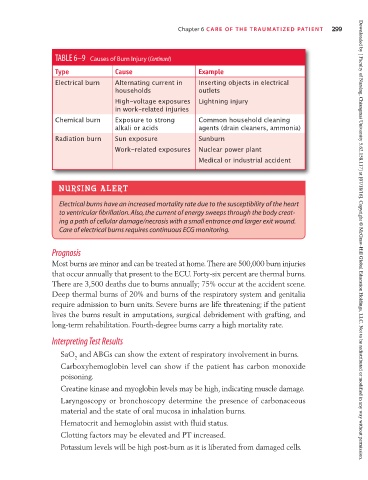
                               TABLE 6–9  Causes of Burn Injury (Continued)
                               Type             Cause                   Example
                               Electrical burn  Alternating current in   Inserting objects in electrical
                                                households              outlets
                                                High-voltage exposures  Lightning injury
                                                in work-related injuries
                               Chemical burn    Exposure to strong      Common household cleaning
                                                alkali or acids         agents (drain cleaners, ammonia)
                               Radiation burn   Sun exposure            Sunburn
                                                Work-related exposures  Nuclear power plant
                                                                        Medical or industrial accident


                                 NURSING ALERT

                                 Electrical burns have an increased mortality rate due to the susceptibility of the heart

                                 to ventricular fibrillation. Also, the current of energy sweeps through the body creat-
                                 ing a path of cellular damage/necrosis with a small entrance and larger exit wound.
                                 Care of electrical burns requires continuous ECG monitoring.                       Downloaded by [ Faculty of Nursing, Chiangmai University 5.62.158.117] at [07/18/16]. Copyright © McGraw-Hill Global Education Holdings, LLC. Not to be redistributed or modified in any way without permission.


                               Prognosis
                               Most burns are minor and can be treated at home. There are 500,000 burn injuries
                               that occur annually that present to the ECU. Forty-six percent are thermal burns.
                               There are 3,500 deaths due to burns annually; 75% occur at the accident scene.
                               Deep thermal burns of 20% and burns of the respiratory system and genitalia
                               require admission to burn units. Severe burns are life threatening; if the patient
                               lives the burns result in amputations, surgical debridement with grafting, and
                               long-term rehabilitation. Fourth-degree burns carry a high  mortality rate.
                               Interpreting Test Results

                                 SaO  and ABGs can show the extent of respiratory involvement in burns.
                                     2
                                 Carboxyhemoglobin level can show if the patient has carbon monoxide
                                   poisoning.
                                 Creatine kinase and myoglobin levels may be high, indicating muscle  damage.
                                 Laryngoscopy or bronchoscopy determine the presence of carbonaceous
                                   material and the state of oral mucosa in inhalation burns.
                                 Hematocrit and hemoglobin assist with fluid status.
                                 Clotting factors may be elevated and PT increased.
                                 Potassium levels will be high post-burn as it is liberated from damaged cells.

