


Page 315 - Critical Care Nursing Demystified
P. 315
300        CRITICAL CARE NURSING  DeMYSTIFIED


                               BUN and creatinine determine if renal failure is occurring.
                               Glucose temporarily elevated due to stress response.

                               WBCs can show if infection is developing.


                            Hallmark Signs and Symptoms
                               Nasal singeing and cherry red mucous membranes can indicate carbon mon-
                               oxide inhalation injury.
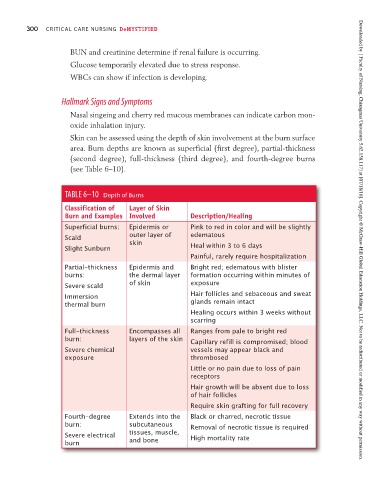
                               Skin can be assessed using the depth of skin involvement at the burn surface
                               area. Burn depths are known as superficial (first degree), partial-thickness
                               (second degree), full-thickness (third degree), and fourth-degree burns
                               (see Table 6–10).


                             TABLE 6–10  Depth of Burns

                             Classification of   Layer of Skin
                             Burn and Examples  Involved        Description/Healing
                             Superficial burns:  Epidermis or   Pink to red in color and will be slightly
                             Scald             outer layer of   edematous
                                               skin                                                             Downloaded by [ Faculty of Nursing, Chiangmai University 5.62.158.117] at [07/18/16]. Copyright © McGraw-Hill Global Education Holdings, LLC. Not to be redistributed or modified in any way without permission.
                             Slight Sunburn                     Heal within 3 to 6 days
                                                                Painful, rarely require hospitalization
                             Partial-thickness   Epidermis and   Bright red; edematous with blister
                             burns:            the dermal layer     formation occurring within minutes of
                             Severe scald      of skin          exposure
                             Immersion                          Hair follicles and sebaceous and sweat
                               thermal burn                     glands remain intact
                                                                Healing occurs within 3 weeks without
                                                                scarring
                             Full-thickness    Encompasses all   Ranges from pale to bright red
                             burn:             layers of the skin  Capillary refill is compromised; blood
                             Severe chemical                    vessels may appear black and
                             exposure                             thrombosed
                                                                Little or no pain due to loss of pain
                                                                receptors
                                                                Hair growth will be absent due to loss
                                                                of hair follicles
                                                                Require skin grafting for full recovery
                             Fourth-degree     Extends into the   Black or charred, necrotic tissue
                             burn:             subcutaneous     Removal of necrotic tissue is required
                             Severe electrical   tissues, muscle,   High mortality rate
                             burn              and bone

