


Page 317 - Critical Care Nursing Demystified
P. 317
302        CRITICAL CARE NURSING  DeMYSTIFIED


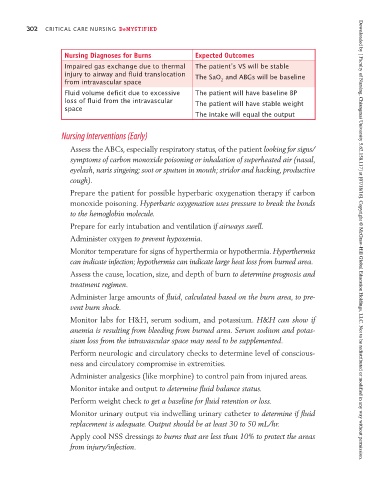
                             Nursing Diagnoses for Burns          Expected Outcomes
                             Impaired gas exchange due to thermal   The patientʼs VS will be stable
                             injury to airway and fluid translocation   The SaO  and ABGs will be baseline
                             from  intravascular space                   2
                             Fluid volume deficit due to excessive   The patient will have baseline BP
                             loss of fluid from the intravascular   The patient will have stable weight
                             space
                                                                  The intake will equal the output


                            Nursing Interventions (Early)
                               Assess the ABCs, especially respiratory status, of the patient looking for signs/
                               symptoms of carbon monoxide poisoning or inhalation of superheated air (nasal,
                               eyelash, naris singeing; soot or sputum in mouth; stridor and hacking, productive
                               cough).

                               Prepare the patient for possible hyperbaric oxygenation therapy if carbon
                               monoxide poisoning. Hyperbaric oxygenation uses pressure to break the bonds
                               to the hemoglobin molecule.
                               Prepare for early intubation and ventilation if airways swell.

                               Administer oxygen to prevent hypoxemia.                                          Downloaded by [ Faculty of Nursing, Chiangmai University 5.62.158.117] at [07/18/16]. Copyright © McGraw-Hill Global Education Holdings, LLC. Not to be redistributed or modified in any way without permission.
                               Monitor temperature for signs of hyperthermia or hypothermia. Hyperthermia
                               can indicate infection; hypothermia can indicate large heat loss from burned area.
                               Assess the cause, location, size, and depth of burn to determine prognosis and
                               treatment regimen.
                               Administer large amounts of fluid, calculated based on the burn area, to pre-
                               vent burn shock.
                               Monitor labs for H&H, serum sodium, and potassium. H&H can show if
                               anemia is resulting from bleeding from burned area. Serum sodium and potas-
                               sium loss from the intravascular space may need to be supplemented.

                               Perform neurologic and circulatory checks to determine level of conscious-
                               ness and circulatory compromise in extremities.

                               Administer analgesics (like morphine) to control pain from injured areas.
                               Monitor intake and output to determine fluid balance status.
                               Perform weight check to get a baseline for fluid retention or loss.
                               Monitor urinary output via indwelling urinary catheter to determine if fluid
                               replacement is adequate. Output should be at least 30 to 50 mL/hr.
                               Apply cool NSS dressings to burns that are less than 10% to protect the areas
                               from injury/infection.

