


Page 329 - Critical Care Nursing Demystified
P. 329
314        CRITICAL CARE NURSING  DeMYSTIFIED


                            sphenoid bone at the site of the “sella turcica.” The pituitary gland is very vas-
                            cular and well protected in this area. It is highly inaccessible and hard to reach
                            for purposes of repair. The pituitary gland acts in partnership with the hypo-
                            thalamus, which actually controls the release and inhibition of its hormones.
                            The hypothalamus is located above the pituitary gland and is connected to the
                            posterior pituitary gland by the “pituitary stem”or “infundibular stalk,” also
                            located at the base of the brain.
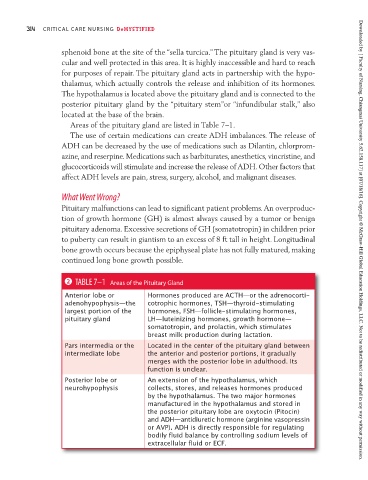
                               Areas of the pituitary gland are listed in Table 7–1.
                               The use of certain medications can create ADH imbalances. The release of
                            ADH can be decreased by the use of medications such as Dilantin, chlorprom-
                            azine, and reserpine. Medications such as barbiturates, anesthetics, vincristine, and
                            glucocorticoids will stimulate and increase the release of ADH. Other factors that
                            affect ADH levels are pain, stress, surgery, alcohol, and malignant diseases.

                            What Went Wrong?
                            Pituitary malfunctions can lead to significant patient problems. An overproduc-
                            tion of growth hormone (GH) is almost always caused by a tumor or benign
                            pituitary adenoma. Excessive secretions of GH (somatotropin) in children prior
                            to puberty can result in giantism to an excess of 8 ft tall in height. Longitudinal   Downloaded by [ Faculty of Nursing, Chiangmai University 5.62.158.117] at [07/18/16]. Copyright © McGraw-Hill Global Education Holdings, LLC. Not to be redistributed or modified in any way without permission.
                            bone growth occurs because the epiphyseal plate has not fully matured, making
                            continued long bone growth possible.


                              2   TABLE 7–1  Areas of the Pituitary Gland
                             Anterior lobe or       Hormones produced are ACTH—or the adrenocorti-
                             adenohypophysis—the    cotrophic hormones, TSH—thyroid-stimulating
                             largest portion of the   hormones, FSH—follicle-stimulating hormones,
                             pituitary gland        LH—luteinizing hormones, growth hormone—
                                                    somatotropin, and prolactin, which stimulates
                                                    breast milk production during lactation.
                             Pars intermedia or the   Located in the center of the pituitary gland between
                             intermediate lobe      the anterior and posterior portions, it gradually
                                                    merges with the posterior lobe in adulthood. Its
                                                    function is unclear.
                             Posterior lobe or      An extension of the hypothalamus, which
                             neurohypophysis        collects, stores, and releases hormones produced
                                                    by the hypothalamus. The two major hormones
                                                    manufactured in the hypothalamus and stored in
                                                    the posterior pituitary lobe are oxytocin (Pitocin)
                                                    and ADH—antidiuretic hormone (arginine vasopressin
                                                    or AVP). ADH is directly responsible for regulating
                                                    bodily fluid balance by controlling sodium levels of
                                                    extracellular fluid or ECF.

