


Page 331 - Critical Care Nursing Demystified
P. 331
316        CRITICAL CARE NURSING  DeMYSTIFIED


                            noted that GH levels tend to increase during sleep, but the reasons are unknown.
                            Severe malnutrition also creates a prolonged elevation of GH.
                               An MRI will determine the extension of a pituitary tumor into surrounding
                            tissue, while a CAT scan with contrast dye will help to localize a pituitary tumor.
                               A complete ophthalmologic examination is also indicated due to potential
                            increased pressure occurring over the optic nerves.


                            Treatment
                            Someone with a pituitary tumor may undergo radiation or surgery to remove
                            the tumor. The surgical term is hypophysectomy and is accomplished using the
                            transsphenoidal approach. An incision is made in the inner aspect of the upper
                            lip and gingiva and the sella turcica is entered through the floor of the nose and
                            sphenoid sinuses.
                               Radiation is indicated when surgery fails to produce successful results. It has
                            also been used to reduce the size of a tumor prior to surgery. Gamma surgery
                            or stereotactic radiosurgery can be used to treat small, inaccessible pituitary
                            tumors. Radiation is delivered to a single site from multiple angles. It occludes
                            the blood vessels feeding the tumor, which starves the tumor.

                            Drug Therapy to Decrease GH Levels                                                  Downloaded by [ Faculty of Nursing, Chiangmai University 5.62.158.117] at [07/18/16]. Copyright © McGraw-Hill Global Education Holdings, LLC. Not to be redistributed or modified in any way without permission.
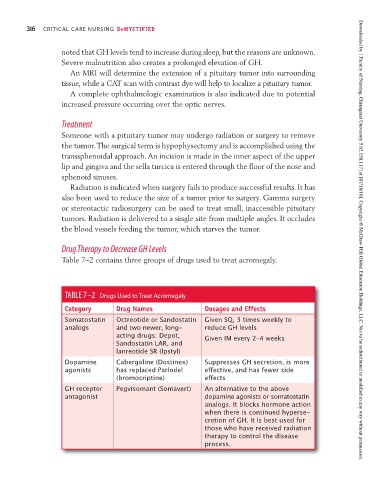
                            Table 7–2 contains three groups of drugs used to treat acromegaly.


                             TABLE 7–2  Drugs Used to Treat Acromegaly
                             Category       Drug Names              Dosages and Effects
                             Somatostatin   Octreotide or Sandostatin  Given SQ, 3 times weekly to
                             analogs        and two newer, long-    reduce GH levels
                                            acting drugs: Depot,    Given IM every 2–4 weeks
                                            Sandostatin LAR, and
                                            lanreotide SR (Ipstyl)
                             Dopamine       Cabergoline (Dostinex)   Suppresses GH secretion, is more
                             agonists       has replaced Parlodel   effective, and has fewer side
                                            (bromocriptine)         effects
                             GH receptor    Pegvisomant (Somavert)   An alternative to the above
                             antagonist                             dopamine agonists or somatostatin
                                                                    analogs. It blocks hormone action
                                                                    when there is continued hyperse-
                                                                    cretion of GH. It is best used for
                                                                    those who have received radiation
                                                                    therapy to control the disease
                                                                    process.

