


Page 335 - Critical Care Nursing Demystified
P. 335
320        CRITICAL CARE NURSING  DeMYSTIFIED


                            sodium loss and fluid retention at the site of the kidney tubules, sodium can be
                            replaced via 3% intravenous hypertonic saline solution infused at a slow rate of
                            0.1 mg/kg per minute on an infusion pump to prevent rapid volume overload
                            and pulmonary edema.

                            Interpreting Test Results
                            Laboratory tests combined with the patient’s clinical profile are the best indica-
                            tors of the amount of ADH released into the bloodstream. The serum ADH test
                            measures the amount of ADH present in a frozen sample of blood.
                               The normal result is 1 to 5 pg/mL. A more accurate direct measurement of
                            ADH is possible through a sensitive radioimmunoassay serum ADH test. BUN,
                            albumin, creatinine, hemoglobin, hematocrit, and electrolyte values may also
                            be affected and should be evaluated.
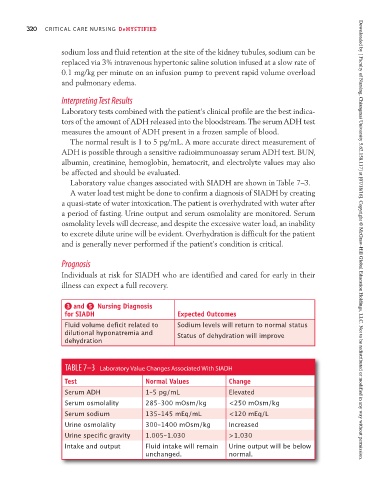
                               Laboratory value changes associated with SIADH are shown in Table 7–3.
                               A water load test might be done to confirm a diagnosis of SIADH by creating
                            a quasi-state of water intoxication. The patient is overhydrated with water after
                            a period of fasting. Urine output and serum osmolality are monitored. Serum
                            osmolality levels will decrease, and despite the excessive water load, an inability
                            to excrete dilute urine will be evident. Overhydration is difficult for the patient
                            and is generally never performed if the patient’s condition is critical.            Downloaded by [ Faculty of Nursing, Chiangmai University 5.62.158.117] at [07/18/16]. Copyright © McGraw-Hill Global Education Holdings, LLC. Not to be redistributed or modified in any way without permission.

                            Prognosis
                            Individuals at risk for SIADH who are identified and cared for early in their
                            illness can expect a full recovery.

                              3  and  5   Nursing Diagnosis
                             for SIADH                       Expected Outcomes
                             Fluid volume deficit related to   Sodium levels will return to normal status
                             dilutional hyponatremia and     Status of dehydration will improve
                             dehydration


                             TABLE 7–3  Laboratory Value Changes Associated With SIADH
                             Test                   Normal Values          Change
                             Serum ADH              1–5 pg/mL              Elevated
                             Serum osmolality       285–300 mOsm/kg        <250 mOsm/kg
                             Serum sodium           135–145 mEq/mL         <120 mEq/L
                             Urine osmolality       300–1400 mOsm/kg       Increased
                             Urine specific gravity   1.005–1.030          >1.030
                             Intake and output      Fluid intake will remain   Urine output will be below
                                                    unchanged.             normal.

