


Page 338 - Critical Care Nursing Demystified
P. 338
Chapter 7  CARE OF THE PATIENT WITH ENDOCRINE DISORDERS        323


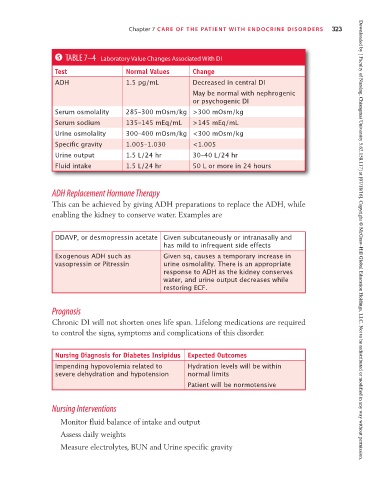
                                5   TABLE 7–4  Laboratory Value Changes Associated With DI

                               Test                Normal Values      Change
                               ADH                 1.5 pg/mL          Decreased in central DI
                                                                      May be normal with nephrogenic
                                                                      or psychogenic DI
                               Serum osmolality    285–300 mOsm/kg >300 mOsm/kg
                               Serum sodium        135–145 mEq/mL     >145 mEq/mL
                               Urine osmolality    300–400 mOsm/kg <300 mOsm/kg
                               Specific gravity    1.005–1.030        <1.005
                               Urine output        1.5 L/24 hr        30–40 L/24 hr
                               Fluid intake        1.5 L/24 hr        50 L or more in 24 hours


                               ADH Replacement Hormone Therapy
                               This can be achieved by giving ADH preparations to replace the ADH, while
                               enabling the kidney to conserve water. Examples are


                               DDAVP, or desmopressin acetate Given subcutaneously or intranasally and
                                                              has mild to infrequent side effects                   Downloaded by [ Faculty of Nursing, Chiangmai University 5.62.158.117] at [07/18/16]. Copyright © McGraw-Hill Global Education Holdings, LLC. Not to be redistributed or modified in any way without permission.
                               Exogenous ADH such as          Given sq, causes a temporary increase in
                               vasopressin or Pitressin       urine osmolality. There is an appropriate
                                                              response to ADH as the kidney conserves
                                                              water, and urine output decreases while
                                                              restoring ECF.


                               Prognosis
                               Chronic DI will not shorten ones life span. Lifelong medications are required
                               to control the signs, symptoms and complications of this disorder.


                               Nursing Diagnosis for Diabetes Insipidus  Expected Outcomes
                               Impending hypovolemia related to      Hydration levels will be within
                               severe dehydration and hypotension    normal limits
                                                                     Patient will be normotensive


                               Nursing Interventions

                                 Monitor fluid balance of intake and output
                                 Assess daily weights
                                 Measure electrolytes, BUN and Urine specific gravity

