


Page 359 - Critical Care Nursing Demystified
P. 359
344        CRITICAL CARE NURSING  DeMYSTIFIED


                               Secondary causes of HHNS include other illnesses such as stroke, MI, pan-
                            creatitis, trauma, sepsis, burns, or pneumonia. Dietary supplements such as TPN
                            (a prolonged intravenous hypertonic glucose infusion), excessive carbohydrate
                            intake from tube feedings, or peritoneal and hemodialysis can also create this
                            syndrome.
                               Most of the signs are the same as with DKA except for the absence of
                            Kussmaul’s respirations and it takes longer to develop as compared to DKA.
                            Volume depletion is usually greater in HHNS than in DKA but fluids should
                            be replaced gradually to prevent fluid overload. Patients should be placed on
                            seizure precautions.


                            Prognosis
                            There is a mortality rate of 10–40% primarily because of delays in seeking
                            medical help, underlying illnesses and vulnerability of the elderly patient.


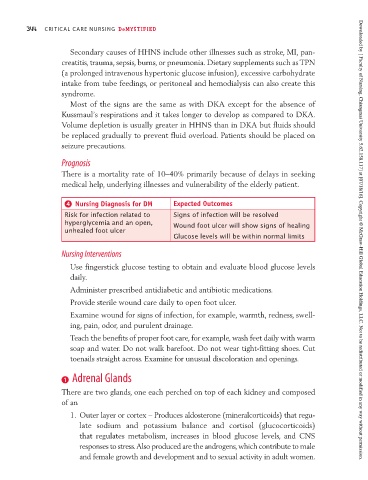
                              4   Nursing Diagnosis for DM  Expected Outcomes
                             Risk for infection related to   Signs of infection will be resolved
                             hyperglycemia and an open,     Wound foot ulcer will show signs of healing
                             unhealed foot ulcer
                                                            Glucose levels will be within normal limits         Downloaded by [ Faculty of Nursing, Chiangmai University 5.62.158.117] at [07/18/16]. Copyright © McGraw-Hill Global Education Holdings, LLC. Not to be redistributed or modified in any way without permission.

                            Nursing Interventions

                               Use fingerstick glucose testing to obtain and evaluate blood glucose levels
                               daily.

                               Administer prescribed antidiabetic and antibiotic medications.
                               Provide sterile wound care daily to open foot ulcer.
                               Examine wound for signs of infection, for example, warmth, redness, swell-
                               ing, pain, odor, and purulent drainage.
                               Teach the benefits of proper foot care, for example, wash feet daily with warm
                               soap and water. Do not walk barefoot. Do not wear tight-fitting shoes. Cut
                               toenails straight across. Examine for unusual discoloration and openings.

                             1  Adrenal Glands
                            There are two glands, one each perched on top of each kidney and composed
                            of an
                               1.  Outer layer or cortex – Produces aldosterone (mineralcorticoids) that regu-
                                 late sodium and potassium balance and cortisol (glucocorticoids)
                                 that regulates metabolism, increases in blood glucose levels, and CNS
                                 responses to stress. Also produced are the androgens, which contribute to male
                                 and female growth and development and to sexual activity in adult women.

