


Page 363 - Critical Care Nursing Demystified
P. 363
348        CRITICAL CARE NURSING  DeMYSTIFIED


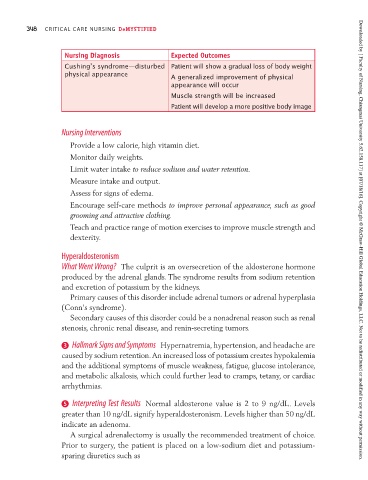
                             Nursing Diagnosis             Expected Outcomes
                             Cushingʼs syndrome—disturbed  Patient will show a gradual loss of body weight
                             physical appearance           A generalized improvement of physical
                                                           appearance will occur
                                                           Muscle strength will be increased
                                                           Patient will develop a more positive body image


                            Nursing Interventions
                               Provide a low calorie, high vitamin diet.
                               Monitor daily weights.

                               Limit water intake to reduce sodium and water retention.
                               Measure intake and output.
                               Assess for signs of edema.
                               Encourage self-care methods to improve personal appearance, such as good
                               grooming and attractive clothing.
                               Teach and practice range of motion exercises to improve muscle strength and
                               dexterity.                                                                       Downloaded by [ Faculty of Nursing, Chiangmai University 5.62.158.117] at [07/18/16]. Copyright © McGraw-Hill Global Education Holdings, LLC. Not to be redistributed or modified in any way without permission.


                            Hyperaldosteronism
                            What Went Wrong?  The culprit is an oversecretion of the aldosterone hormone
                            produced by the adrenal glands. The syndrome results from sodium retention
                            and excretion of potassium by the kidneys.
                               Primary causes of this disorder include adrenal tumors or adrenal hyperplasia
                            (Conn’s syndrome).
                               Secondary causes of this disorder could be a nonadrenal reason such as renal
                            stenosis, chronic renal disease, and renin-secreting tumors.

                             3   Hallmark Signs and Symptoms  Hypernatremia, hypertension, and headache are
                            caused by sodium retention. An increased loss of potassium creates hypokalemia
                            and the additional symptoms of muscle weakness, fatigue, glucose intolerance,
                            and metabolic alkalosis, which could further lead to cramps, tetany, or cardiac
                            arrhythmias.

                             5   Interpreting Test Results  Normal aldosterone value is 2 to 9 ng/dL. Levels
                            greater than 10 ng/dL signify hyperaldosteronism. Levels higher than 50 ng/dL
                            indicate an adenoma.
                               A surgical adrenalectomy is usually the recommended treatment of choice.
                            Prior to surgery, the patient is placed on a low-sodium diet and potassium-
                            sparing diuretics such as

