


Page 37 - Critical Care Nursing Demystified
P. 37
22        CRITICAL CARE NURSING  DeMYSTIFIED


                                                                                  Common carotid artery
                             Apex of right lung                                       Internal jugular vein
                                                                                         Subclavian
                                                                     1                   artery
                            Manubrium
                                                                                           Subclavian
                                                                                           vein
                              Sternum

                                                                                           Fourth rib

                                                                                           Apex of
                               Xiphoid                                                     heart
                                                                         6
                               process
                             Diaphragm


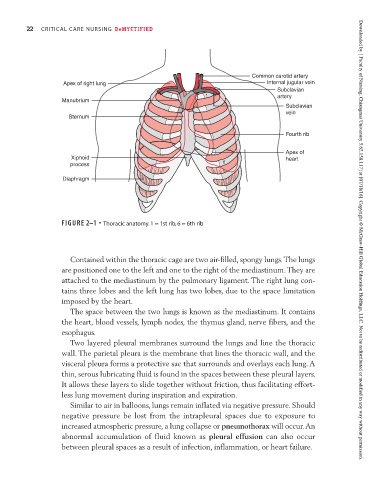
                            FIGURE 2–1  •  Thoracic anatomy. 1 = 1st rib, 6 = 6th rib                           Downloaded by [ Faculty of Nursing, Chiangmai University 5.62.158.117] at [07/18/16]. Copyright © McGraw-Hill Global Education Holdings, LLC. Not to be redistributed or modified in any way without permission.


                               Contained within the thoracic cage are two air-filled, spongy lungs. The lungs
                            are positioned one to the left and one to the right of the mediastinum. They are
                            attached to the mediastinum by the pulmonary ligament. The right lung con-
                            tains three lobes and the left lung has two lobes, due to the space limitation
                            imposed by the heart.
                               The space between the two lungs is known as the mediastinum. It contains
                            the heart, blood vessels, lymph nodes, the thymus gland, nerve fibers, and the
                            esophagus.
                               Two layered pleural membranes surround the lungs and line the thoracic
                            wall. The parietal pleura is the membrane that lines the thoracic wall, and the
                            visceral pleura forms a protective sac that surrounds and overlays each lung. A
                            thin, serous lubricating fluid is found in the spaces between these pleural layers.
                            It allows these layers to slide together without friction, thus facilitating effort-
                            less lung movement during inspiration and expiration.
                               Similar to air in balloons, lungs remain inflated via negative pressure. Should
                            negative pressure be lost from the intrapleural spaces due to exposure to
                            increased atmospheric pressure, a lung collapse or pneumothorax will occur. An
                            abnormal accumulation of fluid known as  pleural effusion can also occur
                            between pleural spaces as a result of infection, inflammation, or heart failure.

