


Page 42 - Critical Care Nursing Demystified
P. 42
Chapter 2  CARE OF THE PATIENT WITH CRITICAL RESPIRATORY NEEDS        27


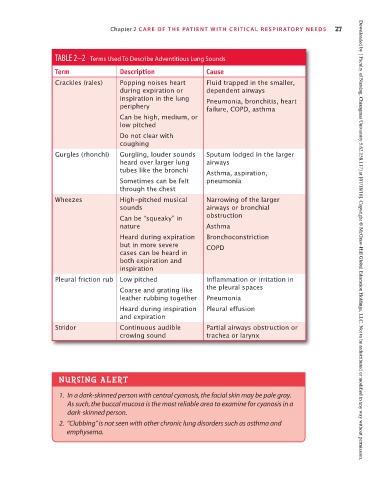
                               TABLE 2–2  Terms Used To Describe Adventitious Lung Sounds
                               Term               Description             Cause
                               Crackles (rales)   Popping noises heart    Fluid trapped in the smaller,
                                                  during expiration or    dependent airways
                                                  inspiration in the lung   Pneumonia, bronchitis, heart
                                                  periphery               failure, COPD, asthma
                                                  Can be high, medium, or
                                                  low pitched
                                                  Do not clear with
                                                  coughing
                               Gurgles (rhonchi)  Gurgling, louder sounds   Sputum lodged in the larger
                                                  heard over larger lung   airways
                                                  tubes like the bronchi  Asthma, aspiration,
                                                  Sometimes can be felt   pneumonia
                                                  through the chest
                               Wheezes            High-pitched musical    Narrowing of the larger
                                                  sounds                  airways or bronchial
                                                  Can be “squeaky” in     obstruction
                                                  nature                  Asthma
                                                  Heard during expiration   Bronchoconstriction
                                                  but in more severe      COPD                                      Downloaded by [ Faculty of Nursing, Chiangmai University 5.62.158.117] at [07/18/16]. Copyright © McGraw-Hill Global Education Holdings, LLC. Not to be redistributed or modified in any way without permission.
                                                  cases can be heard in
                                                  both expiration and
                                                  inspiration
                               Pleural friction rub  Low pitched          Inflammation or irritation in
                                                  Coarse and grating like   the pleural spaces
                                                  leather rubbing together  Pneumonia
                                                  Heard during inspiration   Pleural effusion
                                                  and expiration
                               Stridor            Continuous audible      Partial airways obstruction or
                                                  crowing sound           trachea or larynx


                                 NURSING ALERT

                                 1.   In a dark-skinned person with central cyanosis, the facial skin may be pale gray.
                                   As such, the buccal mucosa is the most reliable area to examine for cyanosis in a
                                   dark-skinned person.
                                 2.   “Clubbing” is not seen with other chronic lung disorders such as asthma and
                                   emphysema.

