


Page 373 - Critical Care Nursing Demystified
P. 373
358        CRITICAL CARE NURSING  DeMYSTIFIED


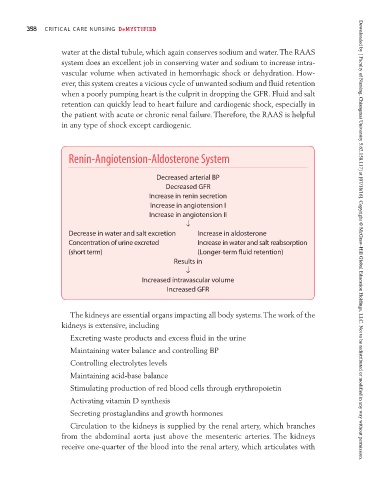
                            water at the distal tubule, which again conserves sodium and water. The RAAS
                            system does an excellent job in conserving water and sodium to increase intra-
                            vascular volume when activated in hemorrhagic shock or dehydration. How-
                            ever, this system creates a vicious cycle of unwanted sodium and fluid retention
                            when a poorly pumping heart is the culprit in dropping the GFR. Fluid and salt
                            retention can quickly lead to heart failure and cardiogenic shock, especially in
                            the patient with acute or chronic renal failure. Therefore, the RAAS is helpful
                            in any type of shock except cardiogenic.


                              Renin-Angiotension-Aldosterone System

                                                       Decreased arterial BP
                                                         Decreased GFR
                                                     Increase in renin secretion
                                                     Increase in angiotension I
                                                     Increase in angiotension II
                                                               ↓
                              Decrease in water and salt excretion   Increase in aldosterone
                              Concentration of urine excreted     Increase in water and salt reabsorption       Downloaded by [ Faculty of Nursing, Chiangmai University 5.62.158.117] at [07/18/16]. Copyright © McGraw-Hill Global Education Holdings, LLC. Not to be redistributed or modified in any way without permission.
                              (short term)                        (Longer-term fluid retention)
                                                            Results in
                                                               ↓
                                                   Increased intravascular volume
                                                          Increased GFR


                               The kidneys are essential organs impacting all body systems. The work of the
                            kidneys is extensive, including
                               Excreting waste products and excess fluid in the urine
                               Maintaining water balance and controlling BP
                               Controlling electrolytes levels
                               Maintaining acid-base balance

                               Stimulating production of red blood cells through erythropoietin
                               Activating vitamin D synthesis
                               Secreting prostaglandins and growth hormones
                               Circulation to the kidneys is supplied by the renal artery, which branches
                            from the abdominal aorta just above the mesenteric arteries. The kidneys
                            receive one-quarter of the blood into the renal artery, which articulates with

