


Page 223 - Color_Atlas_of_Physiology_5th_Ed._-_A._Despopoulos_2003
P. 223
Myocardial Oxygen Supply        Arteriosclerosis (atherosclerosis) of the coronary
                                       arteries leads to luminal narrowing and a resultant
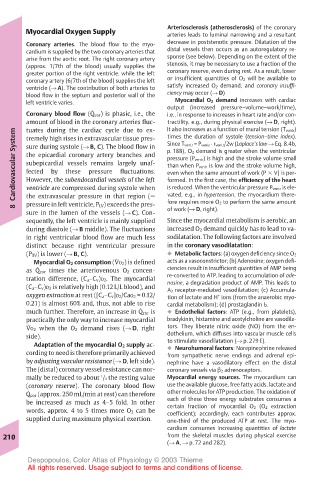
       Coronary arteries. The blood flow to the myo-  decrease in poststenotic pressure. Dilatation of the
       cardium is supplied by the two coronary arteries that  distal vessels then occurs as an autoregulatory re-
       arise from the aortic root. The right coronary artery  sponse (see below). Depending on the extent of the
       (approx. 1/7th of the blood) usually supplies the  stenosis, it may be necessary to use a fraction of the
       greater portion of the right ventricle, while the left  coronary reserve, even during rest. As a result, lower
       coronary artery (6/7th of the blood) supplies the left  or insufficient quantities of O 2 will be available to
       ventricle (! A). The contribution of both arteries to  satisfy increased O 2 demand, and coronary insuffi-
       blood flow in the septum and posterior wall of the  ciency may occur (! D)
       left ventricle varies.           Myocardial O 2 demand increases with cardiac
                      .                output (increased pressure–volume–work/time),
       Coronary blood flow (Q cor) is phasic, i.e., the  i.e., in response to increases in heart rate and/or con-
       amount of blood in the coronary arteries fluc-  tractility, e.g., during physical exercise (! D, right).
                                       It also increases as a function of mural tension (T ventr)
       tuates during the cardiac cycle due to ex-
    Cardiovascular System  sure during systole (! B, C). The blood flow in  Since T ventr = P ventr · r ventr/2w (Laplace’s law ! Eq. 8.4b,
                                       times the duration of systole (tension–time index).
       tremely high rises in extravascular tissue pres-
                                       p. 188), O 2 demand is greater when the ventricular
       the epicardial coronary artery branches and
                                       pressure (P ventr) is high and the stroke volume small
       subepicardial vessels remains largely unaf-
                                       than when P ventr is low and the stroke volume high,
                these
             by
                     pressure
       fected
                            fluctuations.
                                       even when the same amount of work (P ! V) is per-
       However, the subendocardial vessels of the left
                                       formed. In the first case, the efficiency of the heart
       ventricle are compressed during systole when
                                       vated, e.g., in hypertension, the myocardium there-
       the extravascular pressure in that region (!
                                       fore requires more O 2 to perform the same amount
    8  pressure in left ventricle, P LV) exceeds the pres-  is reduced. When the ventricular pressure P ventr is ele-
                                       of work (! D, right).
       sure in the lumen of the vessels (! C). Con-
       sequently, the left ventricle is mainly supplied  Since the myocardial metabolism is aerobic, an
       during diastole (! B middle). The fluctuations  increased O 2 demand quickly has to lead to va-
       in right ventricular blood flow are much less  sodilatation. The following factors are involved
       distinct because right ventricular pressure  in the coronary vasodilatation:
       (P RV) is lower (! B, C).  .    ! Metabolic factors: (a) oxygen deficiency since O 2
         Myocardial O 2 consumption (VO 2) is defined  acts as a vasoconstrictor; (b) Adenosine; oxygen defi-
         .
       as Q cor times the arteriovenous O 2 concen-  ciencies result in insufficient quantities of AMP being
       tration difference, (C a–C v)O 2. The myocardial  re-converted to ATP, leading to accumulation of ade-
                                       nosine, a degradation product of AMP. This leads to
       (C a–C v)O 2 is relatively high (0.12 L/L blood), and  A 2 receptor-mediated vasodilatation; (c) Accumula-
       oxygen extraction at rest ([C a–C v]O 2/CaO 2 = 0.12/  tion of lactate and H ions (from the anaerobic myo-
                                                  +
       0.21) is almost 60% and, thus, not able to rise  cardial metabolism); (d) prostaglandin I 2.
                                .
       much further. Therefore, an increase in Q cor is  ! Endothelial factors: ATP (e.g., from platelets),
       practically the only way to increase myocardial  bradykinin, histamine and acetylcholine are vasodila-
       .
       VO 2 when the O 2 demand rises (! D, right  tors. They liberate nitric oxide (NO) from the en-
       side).                          dothelium, which diffuses into vascular muscle cells
         Adaptation of the myocardial O 2 supply ac-  to stimulate vasodilatation (! p. 279 E).
                                       ! Neurohumoral factors: Norepinephrine released
       cording to need is therefore primarily achieved  from sympathetic nerve endings and adrenal epi-
       by adjusting vascular resistance (! D, left side).  nephrine have a vasodilatory effect on the distal
       The (distal) coronary vessel resistance can nor-  coronary vessels via ! 2 adrenoceptors.
       mally be reduced to about /4 the resting value  Myocardial energy sources. The myocardium can
                        1
       (coronary reserve). The coronary blood flow  use the available glucose, free fatty acids, lactate and
       .
       Q cor (approx. 250 mL/min at rest) can therefore  other molecules for ATP production. The oxidation of
       be increased as much as 4–5 fold. In other  each of these three energy substrates consumes a
                                       certain fraction of myocardial O 2 (O 2 extraction
       words, approx. 4 to 5 times more O 2 can be  coefficient); accordingly, each contributes approx.
       supplied during maximum physical exertion.  one-third of the produced ATP at rest. The myo-
                                       cardium consumes increasing quantities of lactate
  210                                  from the skeletal muscles during physical exercise
                                       (! A, ! p. 72 and 282).
       Despopoulos, Color Atlas of Physiology © 2003 Thieme
       All rights reserved. Usage subject to terms and conditions of license.

