


Page 385 - Color_Atlas_of_Physiology_5th_Ed._-_A._Despopoulos_2003
P. 385
13    Appendix


       Dimensions and Units            Fractions and Multiples of Units
       Physiology is the science of life processes and  Prefixes are used to denote decimal multiples
       bodily functions. Since they are largely based  and fractions of a unit since it is both tedious
       on physical and chemical laws, the investiga-  and confusing to write large numbers. We gen-
       tion, understanding, assessment, and manipu-  erally write 10 kg (kilograms) and 10µg (mi-
       lation of these functions is inseparably linked  crograms) instead of 10 000 g and 0.00001 g,
       to the measurement of physical, chemical, and  for example. The prefixes, which are usually
       other parameters, such as blood pressure,  varied in 1000-unit increments, and the corre-
       hearing capacity, blood pH, and cardiac output.  sponding symbols and conversion factors are
       The units for measurement of these parame-  listed in Table 2. Prefixes are used with base
       ters are listed in this section. We have given  units and the units derived from them
                                                   3
       preference to the international system of SI  (! Table 1), e.g., 10 Pa = 1 kPa. Decimal incre-
       units (Système International d’Unités) for uni-  ments are used in some cases (e.g., da, h, d, and
       formity and ease of calculation. Non-SI units  c; ! Table 2). Time is given in conventional
       will be marked with an asterisk. Conversion  nondecimal units, i.e., seconds (s), minutes
       factors for older units are also listed. Compli-  (min), hours (h), and days (d).
       cated or less common physiological units (e.g.,
       wall tension, flow resistance, compliance) are  Length, Area, Volume
       generally explained in the book as they appear.  The meter (m) is the SI unit of length. Other
       However, some especially important terms  units of length have also been used.
       that are often (not always correctly) used in  Examples:
       physiology will be explained in the Appendix,  1 ångström (Å) = 10 -10 m = 0.1 nm
                                                   -6
       e.g.,  concentration,  activity,  osmolality,  1 micron ( µ) = 10 m = 1 µm
                                                       -9
       osmotic pressure, oncotic pressure, and pH.  1 millimicron (mµ) = 10 m = 1 nm
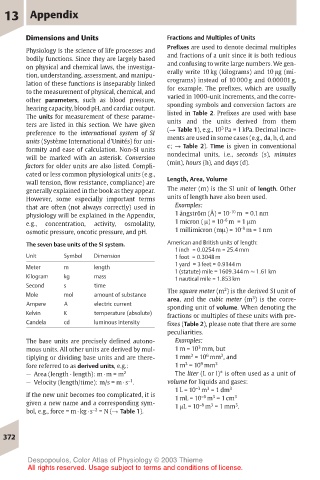
       The seven base units of the SI system.  American and British units of length:
                                        1 inch = 0.0254 m = 25.4 mm
       Unit    Symbol  Dimension        1 foot = 0.3048 m
       Meter   m      length            1 yard = 3 feet = 0.9144 m
                                        1 (statute) mile = 1609.344 m ! 1.61 km
       Kilogram  kg   mass              1 nautical mile = 1.853 km
       Second  s      time                          2
       Mole    mol    amount of substance  The square meter (m ) is the derived SI unit of
                                                          3
                                       area, and the cubic meter (m ) is the corre-
       Ampere  A      electric current  sponding unit of volume. When denoting the
       Kelvin  K      temperature (absolute)
                                       fractions or multiples of these units with pre-
       Candela  cd    luminous intensity  fixes (Table 2), please note that there are some
                                       peculiarities.
       The base units are precisely defined autono-  Examples:
                                              3
       mous units. All other units are derived by mul-  1 m = 10 mm, but
                                            2
                                                   2
                                               6
       tiplying or dividing base units and are there-  1 mm = 10 mm , and
                                              9
                                           3
       fore referred to as derived units, e.g.:  1 m = 10 mm 3
       — Area (length · length): m · m = m 2  The liter (L or l)* is often used as a unit of
                              –1
       — Velocity (length/time): m/s = m · s .  volume for liquids and gases:
                                                3
                                        1 L = 10 m = 1 dm 3
                                             –3
       If the new unit becomes too complicated, it is  1 mL = 10 m = 1 cm 3
                                                 3
                                              –6
       given a new name and a corresponding sym-  1 µL = 10 m = 1 mm . 3
                                              –9
                                                3
       bol, e.g., force = m · kg · s –2 = N (! Table 1).
  372
       Despopoulos, Color Atlas of Physiology © 2003 Thieme
       All rights reserved. Usage subject to terms and conditions of license.

