


Page 388 - Color_Atlas_of_Physiology_5th_Ed._-_A._Despopoulos_2003
P. 388
The relative molecular mass (M r), or molecu-  (voltage = current · resistance). The unit of
      lar “weight”, is the molecular mass of a sub-  electrical resistance is ohm (Ω) (! Table 1).
      stance divided by 1/12 the mass of a  12 C atom.  Conductivity is the reciprocal of resistance
      Since M r is a ratio, it is a dimensionless unit.  (1/Ω) and is expressed in siemens (S), where S
                                        –1
        The amount of substance, or mole (mol), is  = Ω . In physiology, resistance is related to the
      related to mass. One mole of substance con-  membrane surface area (Ω · m ). The recipro-
                                                         2
      tains as many elementary particles (atoms,  cal of this defines the membrane conductance
      molecules, ions) as 12 g of the nuclide of a  12 C  to a given ion: Ω · m –2  = S · m –2  (! p. 32).
                                                 –1
      atom = 6.022 · 10 23  particles. The conversion  Electrical work or energy is expressed in
      factor between moles and mass is therefore:  joules (J) or watt seconds (Ws), whereas electri-
      1 mole equals the mass of substance (in grams)  cal power is expressed in watts (W).
      corresponding to the relative molecular, ionic,  The electrical capacitance of a capacitor,
      or atomic mass of the substance. In other  e.g., a cell membrane, is the ratio of charge (C)
      words, it expresses how much higher the mass  to potential (V); it is expressed in farads (F)
      of the atom, molecule, or ion is than 1/12 that  (! Table 1).
         12
      of a C atom.                                                     and Units
        Examples:                     Direct current (DC) always flows in one direction,
                                      whereas the direction of flow of alternating current
      — Relative molecular mass of H 2O: 18  (AC) constantly changes. The frequency of one cycle
        ! 1 mol H 2O = 18 g H 2O.     of change per unit time is expressed in hertz (Hz).
                         +
      — Relative atomic mass of Na : 23  Mains current is generally 60 Hz in the USA and 50 Hz
        ! 1 mol Na+ = 23 g Na+.       in Europe.                       Dimensions
      — Relative molecular mass of CaCl 2:
         = 40 + (2 · 35.5) = 111      Temperature
        ! 1 mol CaCl 2 = 111 g CaCl 2.  Kelvin (K) is the SI unit of temperature. The
                     –
                              2+
      (CaCl 2 contains 2 mol Cl and 1 mol Ca .)  lowest possible temperature is 0 K, or absolute
                                      zero. The Celsius or centigrade scale is derived
      The equivalent mass is calculated as moles divided
      by the valency of the ion in question and expressed in  from the Kelvin scale. The temperature in
      equivalents (Eq)*. The mole and equivalent values of  degrees Celsius (!C) can easily be converted
      monovalent ions are identical:  into K:
        1 Eq Na = 1/1 mol Na . +        !C = K - 273.15.
            +
        For bivalent ions, equivalent = /2 mole:  In the USA, temperatures are normally given in
                         1
        1 Eq Ca 2+  = /2 mole Ca 2+  or 1 mole Ca 2+  = 2 Eq  degrees Fahrenheit (!F). Conversions between
               1
      Ca .                            Fahrenheit and Celsius are made as follows:
        2+
        The osmole (Osm) is also derived from the mole  !F = (9/5 · !C) + 32
      (see below).                      !C = (!F - 32) · 5/9.
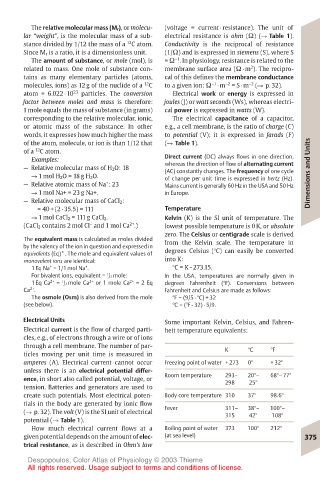
      Electrical Units                Some important Kelvin, Celsius, and Fahren-
      Electrical current is the flow of charged parti-  heit temperature equivalents:
      cles, e.g., of electrons through a wire or of ions
      through a cell membrane. The number of par-   K    !C   !F
      ticles moving per unit time is measured in
      amperes (A). Electrical current cannot occur  Freezing point of water + 273  0!  + 32!
      unless there is an electrical potential differ-  Room temperature  293–  20!–  68!– 77!
      ence, in short also called potential, voltage, or  298  25!
      tension. Batteries and generators are used to
      create such potentials. Most electrical poten-  Body core temperature 310  37!  98.6!
      tials in the body are generated by ionic flow  Fever  311–  38!–  100!–
      (! p. 32). The volt (V) is the SI unit of electrical  315  42!  108!
      potential (! Table 1).
        How much electrical current flows at a  Boiling point of water  373  100!  212!
      given potential depends on the amount of elec-  (at sea level)  375
      trical resistance, as is described in Ohm’s law
       Despopoulos, Color Atlas of Physiology © 2003 Thieme
       All rights reserved. Usage subject to terms and conditions of license.

