


Page 52 - Color_Atlas_of_Physiology_5th_Ed._-_A._Despopoulos_2003
P. 52
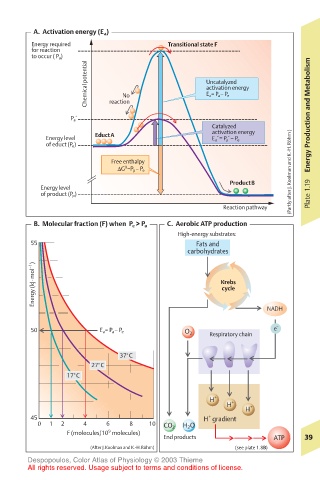
A.  Activation energy (E a )
        Energy required                Transitional state F
        for reaction
        to occur ( P a )
                    Chemical potential  No     Uncatalyzed

                                               activation energy
                                               E a = P a – P e

                 P a ´    reaction                                     Energy Production and Metabolism
                                                 Catalyzed
                                                 activation energy
           Energy level  EductA                  E a ´= P a ´– P e
           of educt (P e )
                          Free enthalpy
                             0
                           ∆G =P p – P e                          (Partly after J. Koolman and K.-H. Röhm )
                                                     ProductB
          Energy level
          of product (P p )                                            Plate 1.19
                                                   Reaction pathway
         B.  Molecular fraction (F) when  P e  > P a  C.  Aerobic ATP production
                                         High-energy substrates:
        55                                   Fats and
                                           carbohydrates
         Energy (kJ·mol –1 )                       Krebs

                                                   cycle

                                                             NADH

        50             E a = P a – P e     O 2  Respiratory chain  e –

                            37°C
                      27°C
                17°C


                                                H +  +
                                                    H    +
                                                        H
                                                +
        45                                     H  gradient
         0  1  2    4    6    8    10  CO 2  H 2 O
                         9
                F (molecules/10  molecules)
                                                                      39
                                      End products             ATP    39
                     (After J.Koolman and K.-H.Röhm)  (see plate 1.8B)
       Despopoulos, Color Atlas of Physiology © 2003 Thieme
       All rights reserved. Usage subject to terms and conditions of license.

