


Page 1013 - Hall et al (2015) Principles of Critical Care-McGraw-Hill
P. 1013
744     PART 5: Infectious Disorders


                   CHAPTER   Biological Warfare                          TABLE 81-1    Categorization of Potential Biological Agents
                    81       Richard H. Savel                           Biological Agent                     Disease
                                                                        Category A
                             Ariel L. Shiloh
                             Vladimir Kvetan                              Variola major                      Smallpox
                                                                          Bacillus anthracis                 Anthrax
                  KEY POINTS                                              Yersinia pestis                    Plague
                                                                          Clostridium botulinum (botulinum toxin)  Botulism
                     • Unlike other mass casualty events, mass exposure to a biological
                    agent is unlikely to be realized until cases start presenting and a     Francisella tularensis  Tularemia
                                https://kat.cr/user/tahir99/
                    high degree of suspicion is needed to realize this.    Filoviruses and arenaviruses (eg, Ebola virus, Lassa virus)  Viral hemorrhagic fevers
                     • Specific knowledge of the various types of agents is required to   Category B
                    help in the diagnosis and management.                 Coxiella burnetii                  Q fever
                     • Victims of class A agents such as plague, anthrax, botulinum toxin,     Brucella spp.  Brucellosis
                    smallpox, and viral hemorrhagic fever are likely to be critically ill
                    and in need of the expertise of intensivists.         Burkholderia mallei                Glanders
                     • Preparedness for a mass casualty event is key in dealing with effec-    Burkholderia pseudomallei  Melioidosis
                    tive care of patients in the hospital setting, containment of spread     Alphaviruses (VEE, EEE, WEE)  Encephalitis
                    of  particularly virulent organisms, and controlling public hysteria.    Rickettsia prowazekii  Typhus fever

                                                                          Toxins (eg, ricin, staphylococcal enterotoxin B)  Toxic syndromes
                                                                          Chlamydia psittaci                 Psittacosis
                                                                          Food safety threats (eg, Salmonella spp, Escherichia coli O157 : H7)
                 INTRODUCTION                                             Water safety threats (eg, Vibrio cholerae, Cryptosporidium parvum)
                 Since the terrorist attacks of September 11, 2001, and the distribution   Category C
                 of mail containing anthrax spores that led to seven deaths in the United     Emerging threat agents (eg, Nipah virus, hantavirus)
                 States, the threat of a large-scale bioterrorist attack has become very real.
                                                                    1
                 A recent report by the Monterey Institute for International Studies found   EEE, eastern equine encephalomyelitis; VEE, Venezuelan equine encephalomyelitis; WEE, western equine
                 a total of 121 biocrimes were committed since 1960, with a reported     encephalomyelitis.
                 sharp rise since 1995.  Reports of biological agent stockpiles and their   Reproduced with permission from Rotz LD, Khan AS, Lillibridge SR, et al. Public health assessment of
                                 2,3
                 weaponization by Iraq and the former Soviet Union, as well as the use of   potential biological terrorism agents. Emerging Infect Dis. February 2002;8(2):225-230.
                 various biological agents by cult organizations such as the Rajneesh cult,
                 Aum Shinrikyo, and Minnesota Patriots, make the possibility of their use
                 by a rogue nation or nonmilitary organization a very real one.  a cloud. This would require an agent to be aerosolized into droplets or
                                                                       particle sizes of 1 to 5 μm in diameter in order to reach and be absorbed
                   Attack of a civilian target would cause a large number of casualties,
                 panic, and civil disruption. There would be a rapid overwhelming of   via the alveolar bed. Particles >5 to 10 μm would be filtered out by or
                                                                       deposited  into  the  upper  respiratory  tract.  However,  many  viruses  like
                 public health facilities and capabilities.  It is highly likely that many if
                                             4,5
                 not the majority of patients would need some degree of critical care such   influenza, viral hemorrhagic fevers, and smallpox can be infective at these
                                                                       sites. Aerosol delivery of an agent would also give rise to unusual presen-
                 as a ventilator or hemodynamic support. Thus the critical care physi-                                   10
                 cian’s role could be a central one that depends on specific knowledge   tations of diseases such as inhalational anthrax and pneumonic plague.
                                                                         A bioterrorist attack through the contamination of food and water is
                 of the various agents, and preattack preparedness, the two cornerstones
                 in dealing with such a catastrophe. The main objectives of this chapter   less likely for several reasons. Most category A agents are not transmit-
                                                                       ted via food and water, while category B agents that can be transmitted
                 are to provide a concise review of individual agents likely to be used in
                 a bioterrorist attack, and focus on key issues related to the intensivist    by these routes usually cause short-term vomiting and diarrhea with a
                                                                       relatively quick recovery. Current water treatment methods effectively
                 in preparing to deal with such an event.
                   The Centers for Disease Control and Prevention’s strategic planning   kill many biological agents and contaminating a water or food supply
                 workgroup categorizes biological warfare agents into groups A, B, and C,   effectively would require large amounts of toxin and bacteria in order to
                 based on capability to cause illness or death, stability of the agent, ease
                 of delivery, ease of mass production, person-to-person transmissibility,
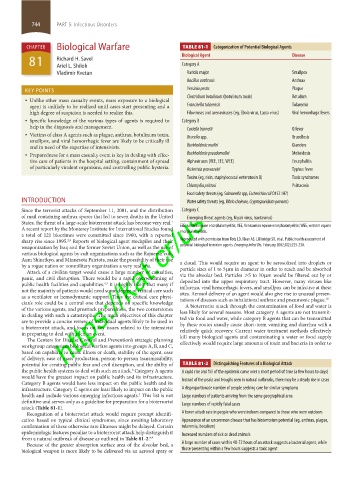
                 potential for creating public fear and civil disruption, and the ability of     TABLE 81-2    Distinguishing Features of a Biological Attack
                 the public health systems to deal with such an attack.  Category A agents   A rapid rise and fall of the epidemic curve over a short period of time (a few hours to days)
                                                       6
                 would have the greatest impact on public health and its infrastructure.   Instead of the peaks and troughs seen in natural outbreaks, there may be a steady rise in cases
                 Category B agents would have less impact on the public health and its
                 infrastructure. Category C agents are least likely to impact on the public   A disproportionate number of people seeking care for similar symptoms
                 health and include various emerging infectious agents.  This list is not   Large numbers of patients arriving from the same geographical area
                                                         7
                 definitive and serves only as a guideline for preparation for a bioterrorist   Large numbers of rapidly fatal cases
                 attack (Table 81-1).
                   Recognition of a bioterrorist attack would require prompt identifi-  A lower attack rate in people who were indoors compared to those who were outdoors
                 cation based on typical clinical syndromes, since awaiting laboratory   Appearance of an uncommon disease that has bioterrorism potential (eg, anthrax, plague,
                 confirmation of these otherwise rare illnesses might be delayed. Certain     tularemia, botulism)
                 epidemiologic features peculiar to a bioterrorist attack help distinguish it   Increased numbers of sick or dead animals
                 from a natural outbreak of disease as outlined in Table 81-2. 8,9
                   Because of the greater absorption surface area of the alveolar bed, a   A large number of cases within 48-72 hours of an attack suggests a bacterial agent, while
                 biological weapon is more likely to be delivered via an aerosol spray or   those presenting within a few hours suggests a toxic agent


            section05_c74-81.indd   744                                                                                1/23/2015   12:37:44 PM

